




1st Edition
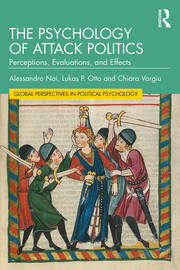
The Psychology of Attack Politics Perceptions, Evaluations and Effects
1 Introduction
2 Perceptions: Attack politics in the eye of the beholder
3 Evaluations: Attack politics is a matter of taste
4 Candidate likeability and backlash
5 Demobilization and radicalization
6 Conclusion
Biography
Alessandro Nai is Associate Professor of Political Communication at the Amsterdam School of Communication Research (ASCoR), University of Amsterdam, The Netherlands. His work deals with the dark side of political communication, radical partisanship, and political violence.
Lukas P. Otto is a senior researcher and head of the team Designed Digital Data at GESIS – Leibniz Institute for the Social Science, Computational Social Science Department, Cologne, Germany. His work focuses on effects of political communication, political trust and cynicism, as well as (mobile and computational) methods in the social sciences.
Chiara Vargiu is a postdoctoral researcher at the Amsterdam School of Communication Research (ASCoR), University of Amsterdam, The Netherlands. Her research explores how citizens make sense of hostile behavior in politics, the psychological mechanisms that drive support for political violence, and how elite rhetoric shapes conflict in democratic societies.
