





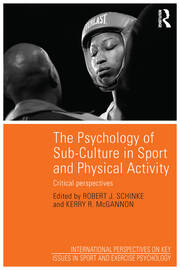
1st Edition
The Psychology of Sub-Culture in Sport and Physical Activity Critical perspectives
Section I: Sociocultural Dimensions of Inclusion/Exclusion in Sport 1. Introduction, Kerry R. McGannon & Robert J. Schinke 2. Applying a Critical Ecological Approach to the Issue of Athlete Abuse in Sport, Gretchen A. Kerr & Ashley E. Stirling 3. A Post-Structuralist Approach to Hazing in Sport, Jennifer J. Waldron 3. Gender Nonconformity, Sex Variation, and Sport, Vikki Krane 4. The Dark Side’ and Beyond: Narrative Inquiry in Professional Golf, Kitrina Douglas and David Carless 5. UltraEmpowering Women: A Feminist Analysis of the Ultramarathoning Culture, Cindra S. Kamphoff & Kelsey Timm Section II: Critiques of the Medical Model, Sport Culture and Sport Research 6. Disability, Sport, and Impaired Bodies: A Critical Approach, Brett Smith and Marie-Josee Perrier 7. A Few Good Men: Male Athlete Eating Disorders, Medical Supremacy and the Silencing of a Sporting Minority, Anthony Papthomas 7. Sport-related Concussion: Critical Issues Moving Forward, Anthony P. Kontos and Erin Reynolds Section III: Self-Reflection and Reflexivity in Sport Psychology Practice and Research 8. BE-KNOW-DO Model of Consulting: An Exploration of How Experiences with Soldiers Affected Me and How My Notions of Self Affected Soldiers’ Experiences, Shannon M. Baird 9. "Standing in the Question": Teaching a Critical Perspective to Developing Sport Psychology Consultants, Leslee A. Fisher and Alicia J. Johnson 10. Caged Quandaries: Mixed Martial Arts and the Politics of Research, Matthew A. Masucci and Ted M. Butryn 11. Confessions of the Disc: A Foucauldian Analysis of Ethics within Ultimate Frisbee, Hamish Crockett
Biography
Robert J. Schinke is Professor and Canada Research Chair in Multicultural Sport and Physical Activity at Laurentian University, Canada.
Kerry R. McGannon is Assistant Professor at Laurentian University, Canada.
'An interesting resource for a graduate seminar in sport psychology or sport studies, this book accomplishes the task of pushing research in the domain of sport psychology into areas that are typically not examined. The book will also help scholars interested in research that challenges the traditional positivistic approach and utilizes critical analysis in the area of sport psychology. Summing Up: Recommended. Graduate students, researchers, faculty, professionals.' - L.J. Burton, University of Connecticut, in CHOICE, April 2015
‘Human beings evolved to become an intensely social species. Our nervous systems (and the behaviours, thoughts, and emotions that arise from them) grow, get damaged, and become healed all within cultural and subcultural (e.g., family, sport, community) contexts. Mainstream sport and exercise psychology has traditionally had a primary focus on individuals, as if mental health, psychological disorders, and performance are athlete-centred issues. Schinke and McGannon, in this highly informative book, have assembled a fine group of authors who show us how socially and culturally bound our lives are and how no one (e.g., athlete, coach, researcher, practitioner) is an island, but rather we are situated on complex continents with many countries, regions, cities, and villages that all shape who we become’. - Mark Andersen, Professor of Sport Psychology, College of Sport and Exercise Science, Victoria University, Australia
‘The Psychology of Sub-Culture in Sport and Physical Activity presents a collection of articles on important and crucial issues untouched by conventional and traditional approaches in sport psychology. The use of critical narrative approaches to capture the cognitions, behavior and feelings of athletes, together with the utilization of reflections and reflexivity in practice, has encouraged me to think critically about my own research interests, methodologies, and practices . . . I strongly recommend the book to sport psychology researchers, practitioners, and students who wish to enhance their knowledge and skills, and use them for the benefit of those who need them.’ - Gershon Tenenbaum, Benjamin S. Bloom Professor of Educational Psychology, Florida State University, USA
