





1st Edition
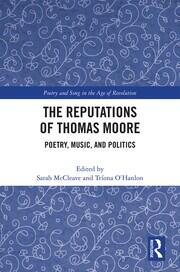
The Reputations of Thomas Moore Poetry, Music, and Politics
List of Figures
Introduction
1 The Role of Community, Network and Sentiment in Shaping the Reputations of Thomas Moore
SARAH McCLEAVE
PART I
Moore’s Reputations as a Poet
2 "A Canadian Boat Song": Origins and Impact in English Canada
D.M.R. BENTLEY
3 Satire, Militarism and the Hunt: Appropriations of Thomas Moore in Sporting Bombay
Máire Ní Fhlathúin
4 Thomas Moore in the Hispanic World
SARA MEDINA CALZADA
5 When Thomas Moore Was the Headline Act: John Boyle O’Reilly, Cultural Politics and the Marketability of Moore
BRIAN G. CARAHER
PART II
Moore’s Reputations as Established through Music Networks
6 The National Airs and Moore’s Reputation in London
Tríona O’Hanlon
7 Romantic Patriotism and the Building of Reputation: The Case of Robert Schumann’s Paradies und die Peri
ANJA BUNZEL
8 "Higher Universal Language of the Heart" The Reputations of Moore’s Irish Melodies in the US
SARAH GERK
Part III
Moore’s Reputations as Established through Political Networks
9 ‘Where bastard freedom waves Her fustian flag in mockery over slaves’: Thomas Moore in America
JENNIFER MARTIN
10 The Influence of Thomas Moore in the Nineteenth-century Greek-speaking World
KATHLEEN ANN O’DONNELL
11 Young Ireland and the Superannuated Bard: Rewriting Thomas Moore in The Nation
Francesca Benatti
Bibliography
Notes on Contributors
Index
Biography
Sarah McCleave is Senior Lecturer in the School of Arts, English and Languages at Queen’s University Belfast; she was Director of the Centre for Eighteenth-Century Studies (2015-2017).
Tríona O’Hanlon is a violinist and musicologist; she was Marie Sklodowska-Curie Research Fellow in Music at the School of Arts, English and Languages at Queen’s University Belfast (2015-2017).
