





1st Edition
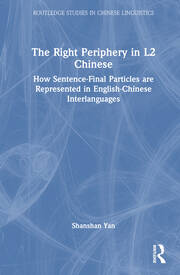
The Right Periphery in L2 Chinese How Sentence-Final Particles are Represented in English-Chinese Interlanguages
List of figures
List of tables
List of boxes
Preface
Acknowledgements
List of abbreviations
1 Introduction
2 Core concepts in SFP and L2 theories
2.1 Chinese SFPs in CP
2.1.1 SFPs in split-CP
2.1.2 Relationship with other CP elements
2.1.3 Head-directionality
2.1.4 Homomorphous SFP: one SFP or several SFPs
2.2 CP in English
2.3 Feature in generative theories
2.3.1 Feature
2.3.2 Feature in L1 and L2 acquisition
2.4 Theoretical frameworks in SLA
2.4.1 L1 transfer
2.4.2 Feature Reassembly Hypothesis
2.4.3 Dormant Feature Hypothesis
2.4.4 Form-meaning connections
2.4.5 Interface Hypothesis
2.5 Summary
3 SFP1 layer: cluster of tense and aspects
3.1 SFP le
3.1.1 Features attached to the SFP le
3.1.2 L2 acquisition of the SFP le
3.2 SFP ne1
3.2.1 Features attached to the SFP ne1
3.2.2 L2 acquisition of the SFP ne1
3.3 Methodological issues
3.4 Summary
4 SFP2 layer: force and clause-typing
4.1 SFP ma
4.1.1 Features attached to the SFP ma
4.1.2 Typing yes-no questions in L2 grammars
4.2 SFP ba1
4.2.1 Features attached to the SFP ba1
4.2.2 Imperative force in L2 grammars
4.3 SFP ne2
4.3.1 Features attached to the SFP ne2
4.3.2 L2 acquisition of the SFP ne2
4.4 Methodological issues
4.5 Summary
5 SFP3 layer: attitudes and discourses5.1 SFP ba2
5.1.1 Features attached to the SFP ba2
5.1.2 Behaviors of the SFP ba2 in L2 grammar
5.2 SFPs a and ne3
5.2.1 Features attached to the SFP a and the SFP ne3
5.2.2 Behaviors of the SFPs a and ne3 in L2 grammars
5.3 Methodological issues
5.4 Summary
6 Interaction among layers and SFPs in terms of their similarities
6.1 Homomorphous SFPs
6.1.1 SFP ba1 and SFP ba2
6.1.2 SFP ne1, SFP ne2, and SFP ne3
6.2 SFPs with similar features
6.2.1 SFP ma and SFP ba2
6.2.2 SFP a and SFP ne3
6.3 Co-occurrence of SFPs
6.3.1 Behaviors and reasons for the (non)co-occurrence of SFPs
6.3.2 Co-occurrence of SFPs in L2 grammars
6.4 Summary
7 Conclusions
7.1 Establishment of the right periphery
7.2 Factors affecting the building of the blocks
7.2.1 L1 transfer
7.2.2 L2 effect
7.2.3 Feature reassembly and feature dormancy
7.2.4 Interfaces
7.2.5 Form-meaning connections
7.3 The role of sentence-final particles in L2 Chinese
7.4 Future directions and pedagogical implications
7.4.1 Future directions for the study of Chinese SFPs
7.4.2 Pedagogical implications
7.5 Summary
Bibliography
Index
Biography
Shanshan Yan is an assistant professor at the School of Chinese as a Second Language, Peking University. She obtained her MPhil in Second Language Education and PhD in Linguistics and Acquisition from the University of Cambridge. Her research expertise includes language acquisition, Chinese linguistics, and Chinese as a second language education.
