




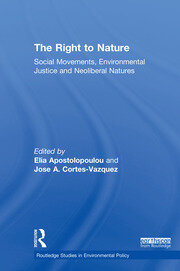

1st Edition
The Right to Nature Social Movements, Environmental Justice and Neoliberal Natures
INTRODUCTION: Neoliberalism and environmental movements around the World after the 2008 financial crash: Defending the right to nature
Elia Apostolopoulou and Jose A. Cortes-Vazquez
PART 1: extractivism and environmental justice movements
- Self-determination as resistance: re-asserting control over natural resources in Colombia.
- Petro-Politics and Local Natural Resource Protection: Grassroots Opposition to the Keystone XL Pipeline in Nebraska.
- Navigating state-led extractivism in Ecuador and Russia: fluid identities and agendas of socio-environmental movements.
- Beyond winning and losing: the rise of the social movement against mega-mining projects in Northern Greece.
- Land rights and justice in neoliberal Mozambique: The case of Afungi community relocations.
- Possibilities and Pitfalls of Environmental Justice Action: Learning from Roşia Montană and Yaigojé Apaporis Anti-mining Struggles.
- Egyptian Environmentalism and Urban Grassroots Mobilisation.
- Landscape and outdoor domestic space towards food sovereignty and environmental regeneration: approaches from Mozambique and Latin America.
- Access to information and the construction of sustainability discourse in the case of the Bus Rapid Transit Transolímpica, in Rio de Janeiro.
- The Political Ecology of Urban Space in Transition.
- Environmental justice claims and dimensions in anti-megaproject campaigns in Europe: The case of the forum against Unnecessary and Imposed Megaprojects.
- Isolation and abstraction to tackle deforestation: The problem of theory as a practical problem in environmental issues.
- Natural capital accounting (NCA): roles in corporate environmental stewardship.
- Offsetting for whom?
- Nature is our Right: Framing a new nature protection debate in Europe.
- Nature’s Rights and Earth Jurisprudence - A New Ecologically-Based Paradigm for Environmental Law
- Nature, Rights and Political Movements
- The commons as organizing infrastructure: Indigenous collaborations and post-neoliberal visions in Ecuador.
- Illegal Camping on ‘Stolen Native Land’.
- Gerontocracies of affect: how the "politics of austerity" have reshaped elder environmental radicalism.
- Humans in the landscape: Low-impact Development as a response to the neoliberal environmental agenda.
Charlotte Christiaens, Lucy Mears, Andy Whitmore and Hannibal Rhoades
James Ordner
Denisse Rodríguez and Julia Loginova
Citizens' Coordinating Committee of Ierissos against gold-copper mining
Kate Symons
Ioana Florea and Hannibal Rhoades
PART 2: Green Struggles against capitalist urbanization And Infrastructure Construction
Noura Wahby
Céline Veríssimo and Leo Name
Camila Nobrega Rabello Alves
Sam Beck
Alfred Burballa-Noria
PART 3: The economic valuation of nature: from academic debates to activist action
Mario Hernandez-Trejo
Les Levidow
Re:Common
Sandra Bell and Friedrich Wulf
Mumta Ito and Massimiliano Montini
Larry Lohmann
PART 4: Tracking alternatives to the neoliberal agenda: radical environmentalism and community action
Tristan Partridge
Amanda K. Winter
Mary Gearey
Julyan Levy
Afterword – the right to nature: lessons learned and future directions
Jose A. Cortes-Vazquez and Elia Apostolopoulou
Biography
Elia Apostolopoulou is a Lecturer at the University of Cambridge, UK.
Jose A. Cortes-Vazquez is an InTalent senior researcher at the University of A Coruña, Spain.
"Since the 2008 economic crisis, neo-liberal capitalism has intensified its onslaught on nature through accelerating resource extraction and privatizing the commons of nature. This book demonstrates exquisitely the havoc wrought by these infernal dynamics and charts possible terrains for thought and action that could lead to a more just and equitable society-nature relationship. A must read for all concerned with the dwindling rights of nature." — Erik Swyngedouw, University of Manchester, UK
"This timely book offers an unprecedented synthesis of cutting-edge research and grassroots activism in pursuit of progressive environmentalism. An exemplar of radical praxis, it will be indispensable for scholars in a wide range of fields as well as activists and policymakers seeking greater conceptual clarity in their work." — Robert Fletcher, Wageningen University, The Netherlands
"A much-needed and compelling account of how the alliance between critical scholarship and social struggles can radically reconfigure environmental policies worldwide. This book makes an outstanding contribution to research engaged in understanding, and supporting, alternatives to the neoliberal agenda." — Stefania Barca, Center for Social Studies, University of Coimbra, Portugal
