




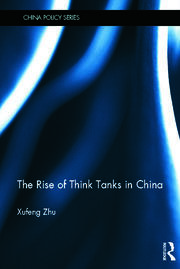
Part 1: Theoretical and Analytical Framework 1. Introduction 2. Think Tanks and China's Think Tanks 3. Influences of China’s Think Tanks Part 2: Different Origins and Behavioral Patterns: Seven Cases 4. Government-Affiliated Semi-Official Think Tanks 5. Non-Governmental Operational Think Tanks with Government Sponsorship 6. Non-Governmental Think Tanks Part 3: Networks, Influences, and Social Consequences: A Nationwide Survey 7. Observations of Think Tank Influence and Networks 8. The Origin of Think Tank Networks 9. Influences and Strategies 10. Social Consequences: Does Think Tanks’ Influence Matter? Part 4: Conclusion 11. Policy Market in China
Biography
Xufeng Zhu is Professor in the Zhou Enlai School of Government at Nankai University, China.
"The book provides a thorough analysis of the role of think tanks in China’s political system... All in all, the book is highly recommended reading. For those interested in policymaking in China, it offers a useful account of the role played by think tanks, which are gradually developing into important actors. It is also beneficial to those interested in the increasingly contested democratic transition in China." - Zhuoyi Wen, City University of Hong Kong, China Information, 2013.
"The Rise of Think Tanks in China is a welcome addition to scholarship" - Michael Keane, Queensland University of Technology, Australia, Pacific Affairs: Volume 87, No. 3 – September 2014.
"Professor Zhu Xufeng, one of China’s emerging public policy scholars, provides an excellent study of China’s think tanks...Overall, the book provides a comprehensive picture of think tanks in contemporary China. It defines the typology and functions of think thanks in the Chinese context, and clarifies the mechanisms of how think tanks could influence China’s policy process and society. The book sheds new light on the policy processes and elite politics in contemporary China." - Xiaoyu Pu, Chinese Journal of Communication, 7:1, 131-134
