





1st Edition
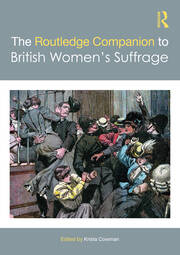
The Routledge Companion to British Women’s Suffrage
Volume Introduction: What was different about the British suffrage campaign?
Part 1: Approaches to the study of British women’s suffrage
1. Locating the suffrage movement in Edwardian politics.
Ian Packer
2. Looking at British suffrage from abroad
Blanca Rodríguez-Ruiz
3. Post-colonial suffrage histories: race and empire in the British suffrage movement
Sumita Mukherjee
4. Life writing and British women’s suffrage
Krista Cowman
5. Local dimensions to women’s suffrage in Britain
June Hannam
6. Social network analysis: mapping suffragettes’ political journeys
Gemma Edwards
7. ‘Revolutionary potential?’ The role of web mapping and other web technologies in the study and democratisation of British suffrage histories.
Tara Morton with Tim Hollies.
Part 2: The material cultures of the British suffrage movement
8. Art and the suffrage campaigns
Zoë Thomas
9. Suffrage news and print media
Maria DiCenzo
10. Purple, white and green: selling militant women’s suffrage
Diane Atkinson
11. Keeping alive the suffragette spirit: curating, collecting and displaying suffrage at the Museum of London
Beverley Cook
12. Collecting suffrage
Elizabeth Crawford
13. Suffrage fiction
Ruth Robbins
14. Suffrage on the Edwardian stage
Naomi Paxton
Part 3: Organisations of the British suffrage movement
15 . Antecedents to the women’s suffrage campaigns
Sarah Richardson
16. ‘You can't kill the spirit, it's like a mountain, old and strong, it goes on and on’: a reassessment of the National Union of Women’s Suffrage Societies: the view from Manchester
Alison Ronan
17. The Women’s Social and Political Union
June Purvis
18. The Women’s Freedom League and discourses of feminism in Great Britain (1907–1914)
Claire Eustance
19. Religious suffrage societies
Carmen M. Mangion
20. Women’s suffrage and political parties
Lyndsey Jenkins
21. Occupational suffrage societies
Alexandra Hughes-Johnson
22. ‘A chivalry that includes and surpasses justice.’ male support for women’s suffrage in Edwardian Britain
Claire Eustance
Part 4: Legacies of the British suffrage movement
23. Suffrage during the First World War
Angela K. Smith
24. Taking a view on suffrage militancy
Laura E. Nym Mayhall
25. What difference did the vote make? Suffrage in Parliament, 1919–1928: the Representation of the People Act, 1918
Pat Thane
26. International connections in the British women’s suffrage movement
Krista Cowman
27. Suffrage centenaries
Mari Takayanagi
28. Suffragette revisited: an interview with Sarah Gavron
Krista Cowman
Biography
Krista Cowman is the Head of the School of History, Politics, and International Relations at the University of Leicester. She has published and broadcast extensively on the suffrage movement for a number of years and was the historical advisor to the 2015 feature film Suffragette.
"An extraordinarily wide-ranging, rich collection of 28 essays by leading scholars on the history of the British women’s suffrage movement. Essays reach back to the early 19th century and come as far forward as 2018 to discuss that year's celebrations, which marked the partial achievement of the vote in 1918, and to anticipate what might happen in 2028 to mark the centenary of granting women the vote on the same basis as men. The volume's main focus, however, is on the intense period just before WW I, when the agitation for the vote was at its most intense. There are fine discussions of the tensions between those who believed in more militant activities, led by the Pankhursts, and the less militant organizations. The number of organizations involved, somewhat hard to keep straight, is amazing."
- Peter Stansky, Emeritus Professor of History, Stanford University, USA
