





1st Edition
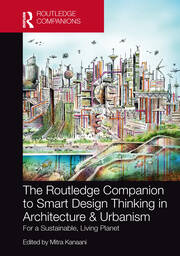
The Routledge Companion to Smart Design Thinking in Architecture & Urbanism for a Sustainable, Living Planet
Preface: The Background of the Idea, Objectives, and the Conceptual Framework of the Publication – Meanings and Various Domains of Smart Design Thinking
Mitra Kanaani
Introduction: The Design Imagination – Is Smart Design Enough?
Harrison Fraker
Prologue: Architects, Smart Futures, and Climate Change
Jim Dator
PARADIGMATIC CATEGORY 1
Various Domains of Smartness in Design Thinking, Theoretical Discourses, and Approaches
1.1. Emerging Smart Design Thinking: A Utopian Futuristic Trend, and an Enduring Theoretical Discourse, ….or an Interim Stance?
1.1.1. Understanding the Emerging Domains of Smart Design Thinking Concepts and Intelligent Design Methodologies in Architecture: Background, Theoretical Tenets, and Various Facets of Smart Thinking in Architectural Design and Conceptualization
Mitra Kanaani
1.1.2 The Smart City Is More than Just Technology and Data Collection: A Critical Stance
Michael Stepner
1.2. The United Nation’s Sustainable Development Goals, How Smart Design Can Promote Equity among the Underserved Inhabitants of Cities
Thomas Fisher
1.3. A Smart Paradigm for Participatory Urban Design
Patrik Schumacher and Shajay Bhooshan
1.4. Smart Responsive Design Thinking in Neuroarchitecture: Towards creating homeostasis balance, equitability, diversity, inclusivity, interactivity, and social performativity in the built environment.
1.4.1. Neuro-Architecture for Cognitive Ecologies: Equitable, Diverse, and Inclusive Smart Design
Fiona Zisch
1.4.2. Smart Design for Promoting Social Performativity and Interactivity of All the Senses
Luis Othón Villegas-Solís
1.4.3. Neuromorphic Architecture at a Turning Point
Michael A. Arbib
1.5. AI and the Morphology of the City _AI’s Dynamic Power in Shaping the Future of Urban Design
Matias del Campo and Sandra Manninger
1.6. Lived Multi-species High-Density Utopias: Smart City Design for Healthy and Diverse Communities in the Post‑Anthropocene
Christiane Margerita Herr
1.7. Smart City and the Concept of Safety: The Meaning of Safety in Smart City’s Organizational Systems and Infrastructure
Ying Huang, Xinyi Yang and Hafiz Usman Ahmed
1.8. Examining the Presence of Intelligent Design in Low-Tech and High-Tech Designs Leading to Eco-Tech Smart Architectural Design Strategies
Shari G. Grant
1.9. Towards Performative, Environmentally Responsive Architecture
Branko Kolarevic
1.10. Smart Urban Resiliency Concepts and Goals: How Can Cities Become Smart but also Sustainable and Resilient
Shabtai Isaac, Miquel Casals, Silvio Carta and Blanca Tejedor
1.11.“Designing Smart Retrofits using Nature’s Patterns”: Designing Sustainability into Existing Communities
Victor Olgyay
1.12. From Smart to Autonomous Cities on the Eve of AI: Some Provocations for Architects and Designers
1.13 Smart Architecture to Reduce Whole-Life Carbon in Buildings and Infrastructure
Paul Toyne
1.14. Blockchain Technology for Smart Thinking: The Intangible Digital Assets for AI‑Enabled Monitoring and Improving Process Performance and Reducing Building Impacts on Ecology
Eric Farr and Poorang Piroozfar
PARADIGMATIC CATEGORY 2
Smart Design Methodologies and Concepts for Intelligent Typologies and User Needs
2.1 Smart Design’s Methodology as Research-Informed-Design
2.1.1 Searching Through Smart Design Methods for Architecture
Carmina Sánchez-del-Valle
2.1.2 For(m) and Against Architectural Intelligence: Design as Research, Again
Brett Steele
2.2 Br(AI)n City: The AI Enhanced City of the Future
Neil Leach
2.3. City as Spaceship – Spaceship as City
2.3.1 City As A Spaceship (CAAS)
Sue Fairburn, Susmita Mohanty and Anna Barbara Imhof
2.3.2 Outer Space Activities and the Future of Smart Habitats on Earth
M. Thangavelu
2.4. Smart Assistive Design Concepts for Enhancing Independent Living in Domestic Environments
Mengni Zhang and Keith Evan Green
2.5. DeafSpace: Cultural Origins, Architectural Applications and Lessons for Dwelling in a Time of Climate Change
Hansel Bauman
2.6. Smart Architecture for the Blind
Chris Downey and Michael Arbib
2.7. People-Centered Smart Learning Ecosystems: Frameworks of reference for optimal design and planning to support individual well-being and learning by being
Carlo Giovannella and Giuseppe Roccasalva
2.8. The Body in Healing Technology
Anna Stroe, Nick Ward and Fiona Zisch
2.9. Smart Design for Human Responsiveness and Movement
2.9.1 Proportioned and Smart Architecture
Tiziana Proietti and Sergei Gepshtein
2.9.2 Smart Home Design for People with Dementia
Julia del Río and Eduardo Macagno
2.9.3 Smart Design and AI for Developmental Disabilities: Characteristics of People with Autism Spectrum Disorders and Other Developmental Disabilities
Kristi Gaines, and Raquel Rodrigues
PARADIGMATIC CATEGORY 3
Smart Materiality
3.1. On Science of the Materials for the Built Environments – The Role of Biomimetics/Biomimicry and Development of Strength and Promoting Natural Forms and Function Inspired by Nature: Bioreceptive Materials for Future Artificial Ecologies – Epizoochory: Evolution of Material and Methods
Mark Tholen
3.2. Smart Ways to Enclose Buildings: Using Super-Strong, Super-Hard, and Flexible Biomaterials Designed with Nano- and Mesoscale Technology
Negar Kalantar, Evan Jones, Margaret Ikeda and Dyche Mullins
3.3. Smart Materials as Architectured Porous and Hybrid Systems to Produce Performative Building Components
Sina Mostafavi, Edgar Montejano Hernandez and Ding Wen Bao
3.4. Fractal-Based Porous Concrete Components Design and 3D Printing
Iasef Md Rian
3.5. Advancing Tunable Acoustics through Smart Materials and Reconfigurable Kerf Structures
Alireza Borhani, Negar Kalantar, Anastasia H. Muliana, Maryam Mansoori and Ali Farajmandi
3.6. Smart Tectonics for the Design of Building Structural Systems
Olga Popovic Larsen and Sander Løkkegaard Benner
3.7. Smart Building Sensibilities: Future Buildings Will Be Smarter, Greener, Cleaner, Connected, Adaptable … and Driven by Digital Rather Than Spatial Technology
Pierce Reynoldson and Ibrahim Odeh
PARADIGMATIC CATEGORY 4
Smart Design for a Changing Climate
4.1. Panarchistic Architecture: A Paradigm in Wildlife Resilience
Melissa Sterry
4.2. Connecting Architecture and Agriculture for a Climate-Smart Future
Henry Gordon-Smith
4.3. Anti-desertification Architecture: Aeolian Assemblies
Stephen Mueller
4.4. The Stacked City as a Model for High‑Density Low‑Carbon Urbanization: Comparison of the Vertical and Horizontal City Models for Urban Development in Hot Climate Zones and their Potential to Achieve Net‑Zero Carbon Emissions
Brian Cody
4.5. Sustainable Smart Cold Living Habitats – Lesson from Antarctica for Other Earth Locations in the Light of Climate Crisis
Ewa Kuryłowicz, Piotr Kuczyński and Karolina Czumaj
4.6. Envisioning Ecological Planning Merged with Smart Technologies and Density
Frederick Besançon
4.7. The Intelligence of Buildings: Information and Bioclimatic Design
William W. Braham
4.8. Smart Energy Harvesting from Natural and Artificial Aquatic Systems
Bastian Steudel
4.9. Amphibious Structures for Smart Flood Risk Reduction and Climate Change Adaptation
Łukasz Piątek and Elizabeth C. English
4.10. Smart Ocean Living: Speculative Design of the North Atlantic Floating Archipelago
Łukasz Piatek
4.11. Aquatic Structures: Designing Marine Futures
Joerg Baumeister
4.12. Expansion in the Water: Growth and Design Processes to Grow Living Islands
Despina Linaraki, Joerg Baumeister, Tim Stevens and Paul Burton
PARADIGMATIC CATEGORY 5
On Smart Design Mobility and in Defiance of Pollution
5.1. Smart Mobility and the Future of Cities
Jaymes Dunsmore
5.2. Smart Airports: Evolving Airports for a More Human‑Focused Journey
Terence Young
5.3. The Future of Advanced Air Mobility and the Role of the Airports
David Tomber
5.4. Space Station Architecture Precursor for a Comprehensive Smarter Architectural Design Study: The Triangular‑Tetrahedral (Tri‑Tet) Space Station
Marc M. Cohen
5.5. Mobile Architecture for, with, and by the People: Smart Design Responses to Climate Change Challenges
Eric Farr and Poorang Piroozfar
PARADIGMATIC CATEGORY 6
Simulation and Advancements Trajectories in Digital Technologies and Data-Driven Smart Designs
6.1. Simulation-Driven Eco-Social Design: Towards Creating Smart Designs
Robert R. Neumayr
6.2. Smart Prototyping: From Data-Driven Mass-Customization to Community-Enabled Co-Production
Sina Mostafavi, Bahar Bagheri, Ding Wen Bao and Asma Mehan
6.3. Architecture, Engineering, and Construction (AEC) Industry 4.0 and Beyond: Building Construction Automation through 3D Printing and Additive Manufacturing Toward Lower Environmental Impacts
Poorang Piroozfar and Eric Farr
6.4. Nesting Fabrication: An Integrated Approach Using Existing Tools to Minimize Waste in Large-Scale Freeform Construction
Alireza Borhani and Negar Kalantar
6.5. Huma-Robot Reconfigurations: Advancing Feminist Technoscience Perspectives for Human-Robot-Collaboration in Architecture and Construction
Gili Ron, Thomas Wortmann, Cordula Kropp and Achim Menges
Biography
Mitra Kanaani is a fellow of the American Institute of Architects (FAIA) and a fellow and Distinguished Professor of the Association Collegiate Schools of Architecture (DPACSA). Mitra holds a DArch, with a focus on Performative Architecture, and an MArch, with a minor in Structural Engineering, as well as a Master of Urban Planning and a BA in Musicology. She is the former chair of the NewSchool of Architecture and an active researcher, author, and editor. She is currently on the California Architect Board, a Global Associate faculty with BIHE, and their liaison with the UIA.
