



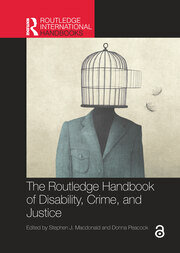


1st Edition
The Routledge Handbook of Disability, Crime, and Justice
Section 1: Introduction to the Routledge Handbook of Disability, Crime, and Justice
Chapter 1: Routledge Handbook of Disability, Crime, and Justice
Stephen. J. Macdonald and Donna Peacock
Chapter 2: Intersections between Disability Studies and Criminological Theory: Time for a Paradigm Shift?
Stephen. J. Macdonald and Donna Peacock
Section 2: Histories of Disability and Crime
Chapter 3: Cesare Lombroso and the Body in the Morgue
Paul Knepper
Chapter 4: Unfit for Labour: Histories of disability and ill-health in the Victorian prison
Helen Johnston and Jo Turner
Chapter 5: The Rise of the Victorian Asylum
Lauren Doyle
Chapter 6: The Road to Broadmoor: Mental Capacity and High Security
Mark Stevens
Chapter 7: Eugenics, Disability and Crime
Donna Peacock
Chapter 8: ‘A Definitive Neurasthenic Temperament?’: The Irish Great War Veteran and the Politicisation of Psychiatry
Michael Robinson
Section 3: Biomedical and Biopsychosocial Criminology
Chapter 9: Neurocriminology: Using knowledge of brain structure and function to explain crime, substance abuse, and offending
Cody Jorgensen
Chapter 10: Online Terrorism Offenders with ADHD: In what ways can ADHD create contextual vulnerabilities and risk?
Zainab Al-Attar and Rachel Worthington
Chapter 11: Neurocriminology, ADHD, and intimate partner violence
Ángel Romero-Martínez
Chapter 12: Biopsychological Approaches to Impairment and Disability, Criminal Behaviour, and Vulnerability: Head Trauma, Imprisonment, and Rehabilitation
Ann Marie Leonard-Zabel
Chapter 13: Therapeutic Relationships in Personality Disorder
Andrew Shepherd
Chapter 14: Autism and Police Interviewing: An Individual, Interpersonal, and Environmental Model of Vulnerability
Ralph Bagnall and Katie Maras
Section 4: Structural Disability Criminology
Chapter 15: Disability, Limits of the Law and Pathways to Prison
Eileen Baldry (with research assistance by Declan Lee)
Chapter 16: Reporting Disability Hate
David Wilkin
Chapter 17: Disability Hate Crimes and Austerity: “The government hates disabled people”
Jane Healy
Chapter 18: Criminal justice responses to learning disabled and autistic victims of sexual violence in the UK
Helen Williams and Alison Jobe
Chapter 19: ‘It’d be the last resort you would ring the Guards’: disabled people’s perceptions and experiences of the police in the search for safe community spaces
Claire Edwards
Chapter 20: Neurodiversity in the Courtroom
Penny Cooper
Chapter 21: Transforming Care: The Role of Institutional Violence
Rebecca Fish
Chapter 22: Disabled people’s lived experiences of access to justice in the criminal justice system in the UK
Andrea Hollomotz and Mark Priestley
Section 5: Cultural Disability Criminology
Chapter 23: Cripping Criminal In/Justice Practices
Ryan Thorneycroft with Nicole L. Asquith
Chapter 24: Landscapes of disability hate
Edward Hall
Chapter 25: Disability Hate Speech and Everyday Life
Leah Burch
Chapter 26: Structural approaches to disability, crime, and victimisation: experiences of d/Deaf individuals in the criminal justice system
Alexandra M. Zidenberg and Holly Blades
Chapter 27: ‘He was sadly a vulnerable young man with learning difficulties’: How the tabloid press represents and labels crimes against disabled people.
Ian Mathews
Chapter 28: Revisiting and reframing the controversial relationship between mental health and violence: Racial disproportionality and disparities of care
Samantha Weston and Julie Trebilcock
Chapter 29: “I'll Give You Justice”: Why the Use of Therapeutic Jurisprudence Is the Best Way to Eradicate Sanism in the Law.
Michael L. Perlin
Chapter 30: Beyond Prison Reform: Ableism & Abolition
Jamelia N. Morgan
Section 6: Realist Disability Criminology
Chapter 31: A critical realist analysis of communication and engagement barriers for ‘vulnerable’ suspects in the police station
Donna Peacock and Patrick Hutchinson
Chapter 32: People with Multiple Sclerosis’s Experiences of Domestic Violence and Abuse
Kharis Hutchison
Chapter 33: Disablist Hate Relationships: The Impact of ‘Low-Level’ Forms of Community Violence on Disabled People’s Quality of Life
Stephen. J. Macdonald, Catherine Donovan, John Clayton and Carol Long
Chapter 34: Digital technology and violence against girls and women with disabilities in low- and middle-income countries: Risks and resources for resilience
Zara Trafford, Karen Soldatić, Lieketseng Ned, and Xanthe Hunt
Chapter 35: Autism, interpersonal violence, and hate crime
Amy Pearson
Chapter 36: Disability and Child Violence
Nikki Rutter
Chapter 37: Disability Awareness: How Do Organisational Learning Theory and Experiential Learning Theory Support Law Enforcement Officers’ Interactions with People with Disabilities?
Olga Vega
Chapter 38: Probation and Ageing
Nichola Cadet
Section 7: Conclusion
Chapter 39: Towards a Criminology of Disability
Stephen. J. Macdonald
Biography
Stephen J. Macdonald is Professor of Criminology and Disability Studies at Durham University. His research focuses on the intersections of disability, criminology, and adult services, emphasising violence against disabled populations, victimisation, criminality, and desistance. He also explores the interplay between disability and criminological theory.
Donna Peacock is Reader in Criminology and Criminal Justice and Head of Social Sciences at the University of the West of Scotland. Her research focuses on 'vulnerability' in police custody settings and the intersections between the disciplines of disability studies and criminology.
