



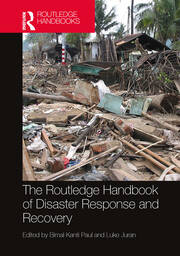


1st Edition
The Routledge Handbook of Disaster Response and Recovery
Lists of figures
List of maps
List of tables
List of boxes
List of contributors
Introduction: Bimal Kanti Paul and Luke Juran
Part I: Disaster Response
Section I: Disaster Response: Key Elements and Activities
1. Key Elements and Activities of Disaster Response: Avantika Ramekar
2. Search and Rescue (SAR): Oriane Longerstaey
3. Emergency Medical Care: Emily Kaplan and Cara Taubman
4. Debris Management and Removal: S. D. Burris
Section II: Channeling Disaster Response
5. Flash Appeal as a Framework for Disaster Response: Subarna Chatterjee
6. Post-Disaster Needs Assessments (PDNAs): Madison Kueny, Grace Blazek and Bimal Kanti Paul
7. Emergency Relief Flows and Determinants of Disaster Aid: Munshi Khaledur Rahman, Bimal Kanti Paul, Nafeeul Alam Walee and Md Sariful Islam
8. Social Networks and Emergency Response: Shakil Bin Kashem and Hyung Jin Kim
Section III: Disaster Relief and Aid Efforts
9. Non-Governmental Organizations (NGOs) as Providers and Distributors of Disaster Assistance: Julia Sherry and Kobel Dubique
10. Participation of Domestic and Foreign Military Forces in Disaster Relief: Rachel Routley, Joshua Hallwright and Matthew Clarke
11. International and Domestic Diplomacy with Disaster Aid: Rob Grace
12. Flow and Management of Disaster Relief: The Case of Bangladesh: Shitangsu Kumar Paul, Md. Shohel Khan and Shehan Tawsif
13. Humanitarianism and Volunteerism in Disaster Response: The Case of Sikh Volunteers during the 2022 Australia Floods: Sweta Baniya and Badal Pokharel
Section IV: Disaster Response Issues and Visions
14. Biases and Vulnerable Populations in Relief Distribution: Emily Kaplan, Chandra Pauline Daniel and Gifty Immanuel
15. Myths Related to Disaster Response: Thomas Evan O’Shea
16. Outbreak of Epidemics during Disaster Response: Laila Shahzad
17. Technology and Technological Methods in Disaster Response: Wendy Stout, Nathan Heazlewood and Ed Cook
Part II: Disaster Recovery
Section V: Disaster Recovery: Key Elements and Activities
18. Key Elements and Activities of Disaster Recovery: Rico Kongsager
19. Disaster Recovery Cycle: Abdulhadi A. Al Ruwaithi
20. Disaster Recovery Outcomes: Yetta Gurtner and David King
21. Sustainable Disaster Recovery: Mitchel Stimers
Section VI: Disaster Recovery Theories and Approaches
22. Disaster Recovery Models: Elizabeth Wagemann and Magdalena Gil
23. Reconfiguring the Kates-Pijawka Recovery Model for a New Era: Stephen Thomas Buckman and Saeideh Sobhaninia
24. Evolution of Recovery Studies and Recovery Duration: Saadia Majeed
25. Social Science Methodologies in Disaster Recovery Research: Naxhelli Ruiz-Rivera
Section VII: Disaster Recovery Contexts
26. The Role of Households and Communities in Disaster Response and Recovery: The Case of the Pacific and Small Island Developing States: Anand Chand and Luke Juran
27. Opportunities that Arise during a Crisis: The Case of Ho Chi Minh City, Vietnam: Mokbul Morshed Ahmad and Tran Thi Minh Hien
28. Sources and Distribution of Internal and External Funding: The Case of Housing Reconstruction after the 2015 Nepal Earthquake: Barsha Manandhar
29. Recovery Among Vulnerable Populations: The Case of 'Forgotten People' after the 2015 Nepal Earthquake: Sanam K. Aksha, Prabin Acharya and Shirish Bhat
30. Computer Modeling to Inform Disaster Recovery: The Case of Hurricane Matthew in North Carolina: Mohammad Yunus Naseri and Luke Juran
Section VIII: Disaster Recovery Issues and Visions
31. Disaster Recovery and Businesses: Charles D. S. Chishiri and Luke Juran
32. Disaster Recovery and Heritage Buildings: David A. Torres Castro
33. Disaster Recovery and Mental Health: BreAnne A. Danzi, Jessica T. Kelly and Jessy L. Thomas
34. COVID-19 and Disaster Response and Recovery: Sarah E. Scales, Abdulhadi A. Al Ruwaithi and Jennifer A. Horney
Conclusions and futures
Index
Biography
Bimal Kanti Paul is a professor of Geography and Geospatial Sciences at Kansas State University who specializes in various aspects of environmental hazards. He has contributed to the field by integrating the social sciences with the physical sciences to address environmental concerns more holistically. Paul has compiled an outstanding publication record, including seven books on environmental hazards as single or co-author. Recently, Stanford University identified Paul among the top 2% of researchers in the world. He was also editor of the Geographical Review (2013–2015), book review editor of The Professional Geographer (2011–2012), and is a fellow of the American Association of Geographers.
Luke Juran is a professor in the Department of Geography and at the Virginia Water Resources Research Center at Virginia Tech. Juran’s research focuses on the human ecology of water and disaster reconstruction with an emphasis on the implementation of community-level water and sanitation systems after disasters. Juran’s research investigates issues related to social vulnerability, water quality, and access to water with particular attention paid to gender and human-environment interactions. In addition to ongoing projects in India, Juran has conducted and supervised research in Bangladesh, Costa Rica, Mauritius, Mexico, Nepal, Sri Lanka, Tanzania, and the United States.
"The Routledge Handbook of Disaster Response and Recovery highlights not only the critical importance of response to and recovery from disasters, but the diversity of approaches to these processes and the ways in which they are studied and seen by people around the world. Understanding the scope with which different experts, people, and cultures comprehend and move through these spaces is absolutely essential to improving our progress through them, and works like this propel our ability to discuss these issues through varied lenses."
Jennifer Trivedi, Disaster Research Center, University of Delaware
“The Routledge Handbook of Disaster Response and Recovery represents a significant contribution to your understanding of these two phases of the emergency management cycle. Spanning topical areas from ‘nuts and bolts’ concepts to real-world and applied situations, this Handbook provides a comprehensive accounting of current challenges and opportunities for response and recovery. The editors have curated a volume worthy of not only a place on the bookshelf, but one that will be pulled down again and again as a reference manual for those interested in diving into the challenges and solutions presented within.”
Christopher T. Emrich, School of Public Administration, University of Central Florida
