




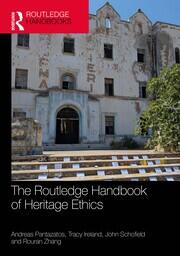
1st Edition
The Routledge Handbook of Heritage Ethics
List of figures
List of contributors
Chapter 1 Heritage and Ethics: an Introduction (Tracy Ireland, Andreas Pantazatos, John Schofield, and Rouran Zhang)
Section 1 Introduction: Frameworks
Chapter 2 Shrunken Heads and Vessels of Wrath: Moralising Cultural Heritage (Geoffrey Scarre)
Chapter 3 Intrinsic and Universal Value in Heritage Ethics (Erich Hatala Matthes)
Chapter 4 The Ethics of Heritage in a Fragile and Burning World (Siobhan Kattago)
Chapter 5 Caring Encounters: Understanding, Care, and the Heritage of the Leros Psychiatric Hospital (Andreas Pantazatos)
Chapter 6 Anticipating Loss, Again: Exploring the Ethical Implications of the
Dialectical Relationship between Heritage and Risk Perception
(Dacia Viejo Rose)
Chapter 7 Queering Museum Heritage: Dis-orienting the Straight and Narrow (Nikki Sullivan and Craig Middleton)
Section 2 Introduction: Difficult Heritage
Chapter 8 Diversity, Values and Authenticity in Negotiating Difficult Heritage (Navin Piplani)
Chapter 9 When Ethics is not Enough: Dealing with Difficult Heritages of the Spanish Post-Civil War at the Local Scale (Carlos Tejerizo-García)
Chapter 10 Ethics of Conservation: Feminicide, Graffiti and National Heritage in Mexico (Cristina Garduño Freeman and Marco Antonio Chavez-Aguayo)
Chapter 11 The Monument that Racism Built: Putting Representations of Slavery and Confederate Monuments into Ethical Perspective (Heather A. O’Connell)
Chapter 12 Oral History, Ethical Practices, and Applications to Australian Migrant Heritage Places (Alexandra Dellios)
Chapter 13 Heritage Tourism and the Ethics of Bearing Witness (Celmara Pocock and Robert Mason)
Section 3 Introduction: Digital Heritage
Chapter 14 Virtual Heritage: How Could It Be Ethical? (Erik Malcolm Champion)
Chapter 15 Digital Heritage and Epistemic Justice (Monika Stobiecka)
Chapter 16 Flying into the Archive: the Ethics of (Post)colonial Digital Heritage in Australia (Ashley van den Heuvel and Tracy Ireland)
Chapter 17 Ethical Approaches to Creative Community Collaborations (Stuart Jeffrey and Lisa McDonald)
Chapter 18 Off the Altar: Reshaping the Sustainable Management of Cultural Heritage in the Context of Authenticity Under the Influence of Digitalization (Jinshi Li and Shaohan Wang)
Chapter 19 Creative Engagements with the Ethics of Heritage Research in the Age of the Data Deluge (Chiara Bonacchi, Kate Hennessy, and Brett Gaylor)
Section 4 Introduction: Heritage Interactions
Chapter 20 Divergences between Community Perspectives and Authorized Heritage Discourses: The Maritime Silk Routes Heritage of Taishan, China (Zhehao Zhao)
Chapter 21 Whose Intangible Cultural Heritage Story? Experiencing Gongfu Tea with a Camera (Jinghong Zhang)
Chapter 22 Toward an Ethics of Naturecultures: Learning from Practice (Steve Brown and Rouran Zhang)
Chapter 23 Community Resilience in Post-disaster Contexts: Negotiating Heritage Authenticity (Cut Dewi and Pratitou Arafat)
Chapter 24 Ethical Dilemmas of Emergency Flood Diversion: Cultural Erosion and Justice in a Marginalized Flood-Prone Village (Kuang Da)
Chapter 25 Education for All: The Ethics of Exhibitions for and of Disabled People within Archaeological Museums (Hua Yu, Tianjin Xu, and Yao Xu)
Chapter 26 The Construction of the Museums System and the Legitimacy of Collecting in China (Siyu Wang)
Section 5 Introduction: Management and Policy
Chapter 27 World Heritage Universalism and its Exclusion of Heritage Cosmologies (Britta Rudolff)
Chapter 28 Gardens and Garages: Everyday Places and the Ethics of Heritage Protection (Luise Rellensmann and John Schofield)
Chapter 29 The Ethics of Partnership: Working Across the Heritage, Humanitarian, and Uniformed Sectors to Protect Heritage During Armed Conflict (Peter G Stone)
Chapter 30 Publicly Ethical, Privately Unethical: The Metropolitan Museum of Art’s Manipulation of Ancient Cultural Heritage (Christos Tsirogiannis)
Chapter 31 Whose Authenticity and Values Count? New Understandings and Ethical Futures for Replicas (Sally Foster)
Chapter 32 Unethical Foodscapes? Heritage and Landscape in the Food System (Graham Fairclough and Ingrid Sarlöv Herlin)
Chapter 33 Institutional Ethics versus Field Experience: A Decolonial Perspective from Heritage Research in Nigeria (J. Kelechi Ugwuanyi)
Chapter 34 Ethical Considerations in Managing the Heritage Values of Lunar Sites (Alice Gorman)
Index
Biography
Andreas Pantazatos is an Associate Professor in Heritage Studies and the Co‑Director of the MPhil in Heritage Studies in the Department of Archaeology at the University of Cambridge.
Tracy Ireland is an Emeritus Professor of Cultural Heritage at the University of Canberra, Australia.
John Schofield is a Professor, teaching cultural heritage management and contemporary archaeology in the Archaeology Department, University of York, UK.
Rouran Zhang is a Professor in the School of Architecture and Urban Planning, Shenzhen University, China.
