





1st Edition
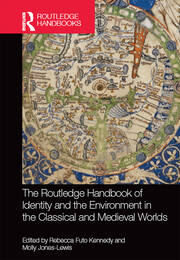
The Routledge Handbook of Identity and the Environment in the Classical and Medieval Worlds
Introduction, "Identity and the Environment"
Rebecca Futo Kennedy and Molly Jones-Lewis
I. Ethnic Identity and the Body
1. Airs, Waters, Metals, Earth: People and Land in Archaic and Classical Greek Thought, Rebecca Futo Kennedy
2. The Ecology Of Health in Dicaearchus and Agatharchides, Clara Bosak-Schroeder
3. The Invention and Purposes of Racial Deformity, Robert Garland
4. Ethnicity in Writers of Physiognomica, Max L. Goldman
5. Health as a Criterion in Ancient Ethnographic Schemes, Eran Almagor
6. 12th century European Environmental Medicine and Ethnic Stereotyping, Claire Weeda
7. Reception of Greek Climatic Theory in Medieval Jewish Science, Abraham Melamed
II. Determined and Determining Ethnicity
8. Colonisation, nostos and the foreign environment in Xenophon’s Anabasis, Rosie Harman
9. The World in a Pill: Local Specialties and Global Remedies in the Greco-Roman World, Laurence Totelin
10. Vitruvius, landscape and heterotopias: how ‘otherspaces’ enrich Roman identity, Diana Spencer
11. Tribal Identity in the Roman World: The Case of the Psylloi, Molly Jones-Lewis
12. Animals, Identity, and the Environment, Jared Secord
13. Who Reads the Stars? Origen's Critique of Astrological Geography, Kathleen Gibbons
14. Climate and Courage, Georgia Irby
15. Nationality, Religious Belief, Geographical Identity, And Sociopolitical Awareness In Abraham Ibn Ezra’s Astrological Thought, Shlomo Sela
16. The Lost Origins of the Daylamites and the Construction of a New Ethnic Legacy for the Buyids, Christine Baker
III. Mapping Ethnicity
17. Location and Dislocation in Early Greek Geography and Ethnography, Philip Kaplan
18. The Terrain of Autochthony: Shaping the Athenian Landscape in the Fifth-Century BCE, Jacquelyn Clements
19. Modelling Ethnicity: Patterns Of Ethnic Evaluation In The Indian Records Of Alexander’s Companions And Megasthenes, Daniela Dueck
20. These happy people: Arabia Felix and the astrological oikoumene of Claudius Ptolemaeus, Joanna Komorowska
21. ‘Ugly as Sin’: Monsters and Barbarians in Late Antiquity, Maja Kominko
22. "Their lands are peripheral and their qi is blocked up": The uses of environmental determinism in Han (206 BCE–220 CE) and Tang (618–907 CE) Chinese interpretations of the ‘barbarians,’ Shao-yun Yang
23. The Races of ‘India’ in the Early Ages of Reconnaissance, Galia Halpern
Biography
Rebecca Futo Kennedy is Associate Professor of Classics at Denison University.
Molly Jones-Lewis is Lecturer in Ancient Studies at University of Maryland, Baltimore County.
"Unique not only for its broad geographical and temporal scope, the handbook is also notable for transcending the common understanding of the "barbarian" as "the Other." It advocates movement away from the dichotomous classification of "us vs. them" (or Greek/Roman vs. barbarian), and likewise discourages the application of modern concepts of race and ethnicity to historical cultures that operated within different contextual frameworks. As such, the essays in this book represent the new directions of current scholarship concerning issues of identity and ethnicity in the ancient and medieval worlds. Thus, this collection of engaging and provocative scholarship challenges readers to shed generalizations and over simplifications and to focus instead on the subtle differences in the ways in which ethnic identities were conceived in past."
- Carrie L. Sulosky Weaver, University of Pittsburgh, in The Classical Journal, published by The Classical Association of the Middle West and South, USA
