





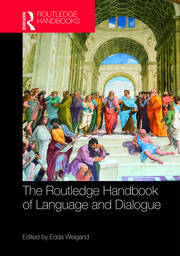
Preface; Part I The State of the Art; 1 Pragmatics: From language as a System of Signs to Language Use -- Jens Allwood; 2 Conversation Analysis -- Lorenza Mondada; 3 Corpus Linguistics -- Marina Bondi; 4 Discourse Analysis -- James Paul Gee; 5 From Pragmatics to Dialogue -- Istvan Kecskes; 6 Psycholinguistic Approaches: Meaning and Understanding -- Susan E. Brennan and Joy E. Hanna; 7 Intersubjectivity in Dialogue -- Per Linell; 8 Dialogue and Literature -- Roger D. Sell; 9 Computational Approaches to Dialogue -- David Traum; 10 From Speech Act Theory to Dialogue: Dialogue Grammar -- Sebastian Feller; 11 The Mixed Game Model: A Holistic Theory -- Edda Weigand; Part II Theoretical Key Issues and Open Debates; 12 Shifting Concepts of Language: Meeting the Challenge of Modelling Interactive Syntax -- Ruth Kempson; 13 The Concept of Language in an Utterance Grammar -- Edda Weigand; 14 The Issue of Theorising: Object-of-study and Methodology -- Arto Mustajoki; 15 Theory and Practice -- Dale Koike; 16 The Sociobiology of Language: What Mirror Neurons Can Tell Us -- Marco Iacoboni; Part III Components of Dialogic Interaction: Human Nature, Institutions and Cultures; 17 Emotion, Reason and the Human Brain -- Marion Grein; 18 Self Interest and Social Concerns -- Jennifer L. Adams; 19 Language as the Originative House of Dialogic Ethics -- Ronald C. Arnett; 20 Dialogue in Institutions -- Sebastian Feller; 21 Dialogue and the Law -- Fritjof Haft; 22 How Culture Affects Language and Dialogue -- Marion Grein; Outlook
Biography
Edda Weigand is Professor Emeritus of Linguistics at the University of Münster, Germany. She is Honorary President and Founding Vice-President of the International Association for Dialogue Analysis (IADA, Bologna) and has been elected Assistant Secretary-General to the Committee of UNESCO’s Fédération Internationale des Langues et Littératures Modernes. She is chief editor of the journal Language and Dialogue and the Dialogue Studies series.
"Eminent linguist Edda Weigand has assembled an inspiring collection of essays written by leading scholars in the field. The opening set of chapters cogently examines the evolution and pivotal junctures in our thinking about language over the past century. This lays solid groundwork for the reader to more fully grasp and appreciate the cutting-edge explorations of language as dialogue that follow in the next two parts. The array of contemporary holistic approaches to theorizing and modeling dialogue take stock of multiple factors – including environment, perception, emotions, subjectivity, social rules and cultural norms – that shape communication and meaning-making practices in real-life dialogue. This opens exciting possibilities for collaborative, interdisciplinary investigations into what it is to be human. This book will undoubtedly become essential reading for linguists, and its far-reaching insights will be of interest to anthropologists, philosophers of mind, and cognitive scientists."
—Trevor H J Marchand, SOAS University of London, UK
"This handbook provides a superb overview of the whole history of linguistics, a history that leads us, in the end, to embrace a dialogical conception of language. According to this perspective, language has to be conceived and analyzed as language in use, but also, and maybe especially, as language as dialogue. With its all-star team of authors, Edda Weigand offers the readers a way to understand how this dialogical program can be sustained for the upcoming years."
—François Cooren, Université de Montréal, Canada
"In this handbook prominent linguists present the consecutive trends of modern linguistics and provide a clear, comprehensive and up-to-date survey of the state of the art in modern linguistics. The key concept of ‘language as dialogue’ opens the door to future research in Dialogue Analysis."
—Franz Hundsnurscher, University of Münster, Germany
