





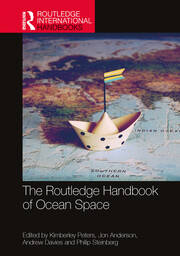
1st Edition
The Routledge Handbook of Ocean Space
Section 1: Ocean Approaches, Ocean Perspectives
1. Introduction: Placing and Situating Ocean Space(s)
Jon Anderson, Andrew Davies, Kimberley Peters and Philip Steinberg
Section 2: Ocean Frameworks, Ocean Knowledges
2. Mapping: Measuring, Modelling and Monitoring the Oceans
Jessica Lehman
3. Science: Histories, Imaginations, Spaces
Antony Adler
4. Representation: Seapower and the Political Construction of the Ocean
Basil Germond
5. Empire: Towards Errant and Interlocking Maritime Spaces of Power
Andrew Davies
6. Frontiers: Ocean Epistemologies: Privatise, Democratise, Decolonise
Leesa Fawcett, Elizabeth Havice and Anna Zalik
7. Culture: Indigenous Māori Knowledges of the Ocean and Leisure Practices
Jordan Waiti and Belinda Wheaton
Section 3: Ocean Economies, Ocean Labour
8. Fishing: Livelihoods and Territorialisation of Ocean Space
Madeleine Gustavsson and Edward H Allison
9. Planning: Seeking to Coordinate the Use of Marine Space
Stephen Jay
10. Docking: Maritime Ports in the Making of the Global Economy
Charmaine Chua
11. Containers: The Shipping Container as Spatial Standard
Matthew Heins
12. Seafarers: The Force that Moves the Global Economy
Maria Borovnik
13. (De)Growth: The Right to the Sea
Maria Hadjimichael
14. Resources: Feminist Geopolitics of Ocean Imaginaries and Resource Securitisation
Amanda Thomas, Sophie Bond and Gradon Diprose
Section 4: Ocean Histories, Ocean Politics
15. Security: Pragmatic Spaces and the Maritime Security Agenda
Christian Bueger
16. Navies: Military Security and the Oceans
Duncan Depledge
17. Discipline: Beyond the Ship as Total Institution
Isaac Land
18. Protest: Contested Hierarchies and Grievances of the Sea
Paul Griffin
19. Solidarities: Oceanic Spaces and Internationalisms from Below
David Featherstone
20. Migration: Security and Humanitarianism across the Mediterranean Border
Charles Heller, Lorenzo Pezzani and Maurice Stierl
Section 5: Ocean Experiences, Ocean Engagements
21. Writing: Literature and the Sea
Stephanie Jones
22. Imaginaries: Art, Film, and the Scenography of Oceanic Worlds
Greer Crawley, Emma Critchley and Mariele Neudecker
23. Swimming: Immersive Encounters in the Ocean
Ronan Foley
24. Surfing: The What, Where, How, and Why of Wild Surfing
Jon Anderson
25. Sailing: The Ocean Around and Within Us
Mike Brown
26. Diving: Leisure, Lively Encounters, and Work Underwater
Elizabeth R. Straughan
Section 6: Ocean Environments, Ocean Worlds
27. Depth: Discovering, ‘Mastering’, Exploring the Deep
Rachael Squire
28. Life: Ethical, Extractive and Geopolitical Intimacies with Nonhuman Marine Life
Elizabeth R Johnson
29. Waves: The Measure of All Waves
Stefan Helmreich
30. Hydrosphere: Water and the Making of Earth Knowledge
Jeremy J Schmidt
31. Ice: Elements, Geopolitics, Law and Popular Culture
Klaus Dodds
32. Islands: Reclaimed: Singapore, Space and the Sea
Satya Savitzky
Biography
Kimberley Peters leads the Marine Governance Research Group at the Helmholtz Institute for Functional Marine Biodiversity (HIFMB), a collaboration between the University of Oldenburg and Alfred Wegener Institute (AWI), Germany.
Jon Anderson is Professor of Human Geography in the School of Geography and Planning, Cardiff University, UK.
Andrew Davies is Senior Lecturer in Human Geography at the University of Liverpool, and is Co-Director of the Centre for Port and Maritime History, a collaborative Centre run by the University of Liverpool, Liverpool John Moores University, UK and Merseyside Maritime Museum.
Philip Steinberg is Professor of Political Geography at Durham University, UK where he is Director of IBRU: Durham University’s Centre for Borders Research and the Durham Arctic Research Centre for Training and Interdisciplinary Collaboration (DurhamARCTIC).
