




1st Edition
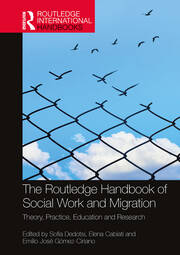
The Routledge Handbook of Social Work and Migration Theory, Practice, Education and Research
Chapter One – Introduction
Sofia Dedotsi, Elena Cabiati and Emilio José Gómez-Ciriano
Part I – More Than One Theory for Social Work and Migration: A Critical Overview
Chapter Two – (Anti-)oppressive practice with migration – A conceptual analysis for social work
Sofia Dedotsi
Chapter Three – Critical Social Work Ethics and Intersectionality: Considerations for Working with People from Refugee Backgrounds
Kim Robinson
Chapter Four – From deportability to grievability: A theoretical perspective on the intersections of social work and migration
Marcus Herz
Chapter Five – Social work discourses around the concept of ‘culture’
Elena Cabiati
Chapter Six – Beyond ‘commonsense’: Theorising social work and migration
Jonathan Parker
Chapter Seven – The transition towards superdiversity challenges social work
Dirk Geldof
Part II – Working with Migrants: Social Work Practice and Experiences
Chapter Eight – Bridging borders: The transformation of border and asylum policies and the impact on social work practice
Alberto Ares Mateos and Jennifer Gómez Torres
Chapter Nine – Rites of passage: Emotional and geographic journeys of refugees from their home in Africa to Northern Italy
Terry Koenig, Jon Hudson, Abhishek Juneja, Michael Williams, Paolo Nardi and Giulio Cesare Tersalvi
Chapter Ten – “We are all together” Social work and internal displacement within complex emergencies: Practitioners’ perspectives on practice in Northwest Syria
Karen Paul and Myriam Denov
Chapter Eleven – Unaccompanied minors on the move: Trauma-informed approaches and the healing power of storytelling in social work practices
Marina Rota, Ine Lietaert and Ilse Derluyn
Chapter Twelve – Unaccompanied minors in Mexico: Between support and institutional violence. Perspectives from social work practice
Sandra E. Mancinas Espinoza and Elisa Cerros Rodriguez
Chapter Thirteen – Transnational social work on the brink of practice and politics: Supporting family reunification of refugee families
Pascal Debruyne, Mieke Groeninck, Kaat Van Acker and Mieke Schrooten
Chapter Fourteen – Social work practice with forced migrants: Trauma-informed resilience perspective
Nicole Dubus
Chapter Fifteen – The promise and challenges of anti-oppressive social work with young people from refugee backgrounds
Dorothee Hölscher, Noémie Rigaud, Paddy O’Regan and Karen Healy
Chapter Sixteen – Rights-based social work with unaccompanied children and young people: Tensions and opportunities
Rachel Larkin
Chapter Seventeen – Women with a migrant background facing intimate partner violence (IPV): Implications for social work from an intersectional perspective
Maria Turati and Marco Grassini
Chapter Eighteen – Integration challenges for highly educated women migrants: Impacts on professional identity and social work
Sara Verderber
Chapter Nineteen – Critical and radical voices from the frontline: Advocacy and collective action in social work on migration amidst crises in Greece
Lefkothea Rizopoulou
Part III - Teaching and Learning About Migration: The Role of Social Work Education
Chapter Twenty – (De-) colonial perspectives on migration in social work education
Linda Harms-Smith
Chapter Twenty-one – Educating social workers for anti-racist practice with Unaccompanied Asylum-Seeking Children (UASC)
Prospera Tedam
Chapter Twenty-two – Homesick for mobility: A pedagogical invitation for critical social work to relationally engage Indigenous and migrant justice
Soma Chatterjee and Virginia Stammers
Chapter Twenty-three – On maps, lanterns, food and compasses: Human rights and migration in social work education
Emilio José Gómez-Ciriano
Chapter Twenty-four – The transformative power of an integration journey in social work education: A case study on cooperation with an expert by experience with migration background
Kristel Driessens, Veronique Kabonga and Gwen Schoeters
Part IV – Social Work Research and Migration: Ethics and Methodological Challenges
Chapter Twenty-five – Decolonial perspectives for epistemic justice: challenges for social work research
Gianinna Muñoz-Arce
Chapter Twenty-six – Are procedural ethics enough?: Pursuing ethical social work research with refugee and forced migrant populations
Neil Bilotta, Rosemary R. Carlton and Hadijah Mwenyango
Chapter Twenty-seven – Navigating ethical complexities in research with people of refugee background: Care, time, and reflexivity as key considerations
Muireann Ní Raghallaigh and Zoë O'Reilly
Chapter Twenty-eight – Art-based research with unaccompanied migrant children
Glynis Clacherty
Chapter Twenty-nine – Ethnography of migrations from social work: Approaches from Mexico
Alma Leticia Flores Ávila and Elisa Cerros Rodríguez
Chapter Thirty – Epilogue
Sofia Dedotsi, Elena Cabiati and Emilio José Gómez-Ciriano
Biography
Sofia Dedotsi is an Assistant Professor at the Department of Social Work at the University of West Attica, Athens, Greece.
Elena Cabiati is a registered social worker and Full Professor at Università Cattolica del Sacro Cuore (campuses of Milano and Brescia), Italy.
Emilio José Gómez-Ciriano is an Associate Professor at the Faculty of Social Work (Cuenca Campus) at Castilla-la Mancha University, Spain.
