





1st Edition
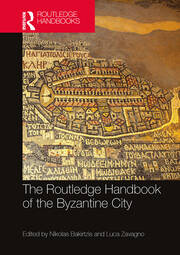
The Routledge Handbook of the Byzantine City From Justinian to Mehmet II (ca. 500 - ca.1500)
List of Illustrations
List of Contributors
Introduction
Nikolas Bakirtzis and Luca Zavagno
PART I - Theory and Historiography
1 The Byzantine City and its Historiography
Luca Zavagno
2 Theorizing Byzantine Urbanity: The City Constituting Memory, Memory Constituting the City
Myrto Veikou
3 The Byzantine City in the Literary Sources
Helen Saradi
4 Methodologies for Byzantine Urban Studies
Michael J. Decker
5 Spatial Organization in Late Byzantine Cities (13th・14th Centuries)
Tonia Kiousopoulou
PART II - Geographies of the Byzantine City
6 Cities on the Black Sea Coast and the Circumpontic Exchange Network (c. 500・700)
Andrei Gandila
7 The Byzantine ‘City’ in Asia Minor
Ufuk Serin
8 Insular Urbanism in Byzantium
Luca Zavagno
9 The City in the Byzantine ‘Italies’
Enrico Cirelli
10 Urbanism in Syria and Palestine Between the 7th and 9th Centuries
Ian Randall
PART III - Architecture and the Built Environment
11 Domes in the Urban Skyline: The Case of Sts. Sergius and Bacchus and its Transformations through Time
Nikolaos Karydis
12 Fortifications and the Making of the Byzantine City
Nikolas Bakirtzis
13 Monumentality and the Byzantine City
Maria Cristina Carile
14 Maintained, Stored and Protected: Water and the Byzantine City
E. Giorgi
15 Islamic City, Ottoman City: Byzantine Prousa to Ottoman Bursa
Suna Cağaptay
16 Two Views of Ports and Maritime Communities in the Byzantine Mediterranean: Constantinople and Amalfi
Michael Jones and Matthew Harpster
17 Alexandria after Antiquity: A City in Transition
Athanasios Koutoupas
PART IV - Daily Life, Visual and Material Culture
18 “The Arts and the Byzantine City”
Ioli Kalavrezou
19 On Early Byzantine Images of Poleis: Meanings and Messages
Jenny P. Albani
20 The Consumptive Capital: Commercial Activities and Ceramic Finds at Constantinople (ca. 500・1000)
Joanita Vroom
21 Pera Ianuensium Pulcherrima Civitas Est: Creating a Genoese Identity on the Golden Horn (1261・1453)
Mabi Angar
Biography
Nikolas Bakirtzis is an Associate Professor at The Cyprus Institute in Nicosia, Cyprus. His research focuses on Byzantine monasticism, medieval cities and fortifications, and the island landscapes of the Byzantine, medieval, and early modern Mediterranean. As the Director of the Andreas Pittas Art Characterization Labs, he leads research on the materiality of medieval and early modern art enhanced through the use of advanced digital and analytical methods. His work has received support from the European Commission, the Cyprus Research and Innovation Foundation, the Princeton Seeger Center for Hellenic Studies, the A.G. Leventis Foundation, and the Getty Research Institute.
Luca Zavagno is an Associate Professor of Byzantine Studies at Bilkent University, Turkey. He is the author of many articles and books on the early medieval and Byzantine Mediterranean. His research focuses on Byzantine urbanism and medieval Mediterranean insularity. He has been awarded the Dumbarton Oaks Summer Fellowship twice (in 2011 and 2016) as well as the prestigious Stanley Seeger Fellowship of the Hellenic Studies Center at Princeton University (2012), the Newton Mobility Grant (2018), and he has been twice a fellowship at Center for Advanced Studies ‘Migration and Mobility in Late Antiquity and the Early Middle Ages’ at the University of Tubingen, Germany (2022 and 2023).
