




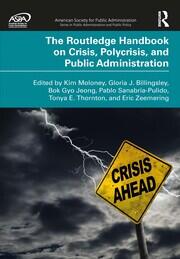
1st Edition
The Routledge Handbook on Crisis, Polycrisis, and Public Administration
AN INTRODUCTION
1. New Realities: Constancy of Crisis and Poly-Crisis for Public Administration
Kim Moloney, Bok Gyo Jeong, Pablo Sanabria-Pulido
SECTION I – STRUCTURES IN CRISIS: A NORTH-SOUTH DIALOGUE
2. How citizens’ perceptions of management capacity and trust in government change during a worldwide crisis? The case of Colombia during the COVID-19 pandemic
Nathalie Méndez, Pablo Sanabria-Pulido
3. Crisis Management, Transnational Administration, and Administrative Sovereignty in Developing Countries: Problems of a National Disaster and Management Organization in Ghana
Frank L. K. Ohemeng, Rosina K. Foli
4. The performance of local government in addressing disaster risk and climate change: a comparative analysis of Brazil, Mexico, and Paraguay
Eduardo Grin, Ady Carrera, Andrew Nickson
5. The Role of INTERPOL Coordinating a Global Public Policy in the Context of Unequal National Public Administration Capacities: A Case Study of the Transnational Administration Efforts to Face COVID-19 Crimes as Emerging Threats
Gerardo Bonilla-Alguera
6. State capacity to address dual crises: the negative interaction between the COVID-19 Pandemic and Violence against Women in Argentina and Mexico
Mariana Chudnovsky, Diana Martínez
7. Navigating Crisis and Fragmegration in the Public Sector: A Heterarchical Approach
Dana-Marie Ramjit
SECTION II -- AGENTS IN CRISIS: A CROSS-ACTOR DIALOGUE
8. Sendai Framework for Disaster Risk Reduction, Transnational Crisis Management System, and the United Nations: Following the 2015 Nepal Earthquake
Jungwon Yeo, Bok Gyo Jeong
9. Nongovernmental Organizations in Africa as Agenda in Crisis Response: The Case of Ghana
James K. Agbodzakey, Sandra Schrouder
10. Public Policy and Flash Floods: Crisis Management in Selected Indian Ocean Islands
Harshana Kasseeah, Sheetal Sheena Sookrajowa
11. Local Government Strategy and Crisis in the United States: A Community Resilience / Systems Perspective
Brian D. Williams
SECTION III – HUMAN CAPITAL AND INFORMATION TECHNOLOGY IN CRISIS
12. Intersecting Crises in Local Government Employment in the United States: COVID-19, the Grey Tsunami, and Workforce Evolution
Kimberly L. Nelson, Brad A. M. Johnson
13. Roles of Nonprofit Organizations during the Emergency and Extreme Events: The Case of Continuum of Care (CoC) Homeless Serving Nonprofit Organizations during the COVID-19 Pandemic
Simon A. Andrew, Hee Soun Jang, Vaswati Chatterjee, Sara Ford
14. Technology and crisis: butterfly or domino effect in governing a turbulent world?
Veronica Junjan, Islam Bouzguenda, Caroline Fischer
15. Training Citizen Responses during a Crisis via Innovative ICT-based Administrative Actions in South Korea
Shin Kue Ryu
16. Critical Success Factors for Government Crisis Communication over Social Media in Emergency Management
Nilay Yavuz, Naci Karkin, Mete Yildiz
SECTION IV – PUBLIC SECTOR COMMUNICATION IN CRISIS
17. Public Sector Communication in Federal Systems of Government: Exploring Successes and Failures in Crisis Communication
Saahir Shafi, Daniel J. Mallinson
18. Information Capacity and the Implementation of Social Programs in Latin America
Rik Peeters, Guillermo M. Cejudo, César Rentería
19. COVID-19 Vaccine Hesitancy and Public Trust in Government: Implications for the Locus of Public Administration in South Africa
Nqobile Sikhosana, Ogochukwu Nzewi
20. Legitimacy deficit during emergencies: The impact of administrative discretion
Héctor David Rojas Villamil, Juan Carlos Covilla Martínez
21. Network Governance for Coordinated Disaster Response
Ratna Okhai, Naim Kapucu
22. Diffusion in times of Political Polarization: An Analysis of Face Mask Policy Adoption in the United States
Davia C. Downey, William M. Myers
23. Impacts of Pandemic Planning Preparedness on select U.S. Cities during COVID-19
Karissa D. Bergene
SECTION V – PRACTITIONERS IN CRISIS
24. COVID-19 and the Non-Profit Dimension: The ASPA Experience
William Shields, Jr.
25. Population Decrease and Local Government’s Measure: Lessons from Japanese Prefecture’s Experiences
Kazuyuki Ishida
26. Religion, Crisis, and Public Policy
Gloria J. Billingsley
27. Understanding the Impacts and Associated Lessons of Turnover for Emergency Management and Public Health Leaders in North Carolina during the COVID-19 Pandemic
Hardin Watkins
28. Fulfilling a volunteer-driven mission in the era of social distancing
Leslie Hale
29. Using Communication Science to Inform Responsible Crisis Communication
Holli H. Seitz
IN CONCLUSION
30. Conclusion
Eric Zeemering, Gloria Billingsley, Tonya E. Thornton
Biography
Kim Moloney is an Associate Professor at the College of Public Policy at Hamad Bin Khalifa University, Qatar. Her latest books are her sole-authored Who Matters at the World Bank (2022) and separately, her co-editing (with Diane Stone) of The Oxford Handbook of Global Policy and Transnational Administration (2019).
Gloria J. Billingsley is a Professor of Public Policy and Administration at Jackson State University, USA, with over 20 years of teaching experience and building community partnerships. Her research includes issues on voting rights; race, gender, and class; minority participation in health research, and issues of spirituality and health.
Bok Gyo Jeong is an Associate Professor of Public Affairs at Kean University, USA. His research interests include comparative civil society, global/transnational policy issues, nonprofit higher education, social entrepreneurship/economy, UN-NGO partnership, and collaboration between government and nonprofits.
Pablo Sanabria-Pulido is a Professor at Universidad EAFIT, Colombia. He studies and teaches the design, formulation, and implementation of public policies and the managerial challenges that public service organizations and public officials face, aiming to disentangle how to make public organizations work better, particularly at the national and local levels. His research has been recognized and published in key international public administration and policy outlets.
Tonya E. Thornton is the Director of Critical Infrastructure Protection with the Global Connective Center. Her expertise focuses on emergency management and grid security to provide resiliency solutions. She is a member of the American Society for Public Administration and is Treasurer for its Section on Emergency and Crisis Management.
Eric Zeemering is an Associate Professor and MPA Director at the University of Georgia, USA.
“This exceptional book introduces the concepts of polycrises and crisis-constant as a framework for understanding the dynamics that near-continual change and uncertainty create for public administrators responsible for managing public services. Initiated in response to COVID-19, a remarkable roster of international co-authors present the problem of polycrisis in global context.”
Louise Comfort, Professor Emerita, University of Pittsburgh, USA
“The Covid-19 pandemic trained the spotlight on our new macro reality – multi-layered and sequential crises that know no geographic boundaries. Our new reality demands an expanded analytical toolbox where we can nimbly confront our real-time polycrisis. The authors in this volume do exactly that, construct a toolkit for effectively charting a clear-eyed path forward that embraces the realities of our crises today.”
Victoria DeFrancesco Soto, Dean and Professor, Clinton School of Public Service, University of Arkansas, USA
“Crises are global, pandemics are global – but public administration scholarship, often enough, is not. Narrow Western perspectives abound, both regarding what is studied and how. The Routledge Handbook on Crisis, Polycrisis, and Public Administration however is truly global in outlooks and topics and therefore makes a significant contribution, not only to its vital topic, but also to the public administration discipline generally.”
Wolfgang Drechsler, TalTech, UCL IIPP, Universitas Indonesia, and Harvard University
“The Routledge Handbook on Crisis, Polycrisis, and Public Administration is a vital resource offering profound insights into handling complex crises across local, national, and global landscapes. Merging detailed analysis with actionable guidance, it is a must-read for scholars and practitioners interested in enhancing capacity for crisis management during difficult times.”
Robert C. Orr, Professor and Dean, School of Public Policy, University of Maryland, USA
“With a diverse set of authors and cases, this book provides an excellent starting point with key lessons for anyone charged with organizing and communicating with the public in times of disaster or societal crisis. For students who want to go into public service or humanitarian work, the book provides a valuable discussion of challenges the public sector faces in managing significant contemporary crises and disasters. The crosscutting collaborative research the handbook reflects, is precisely the kind of joint approach we need to build capacity and resilience in the face of adversity.”
Lina Svedin, Professor, School of Advanced Air and Space Studies, Air University, USA
“In recent years, rising systemic turbulence, such as climate emergencies, public health emergencies, geopolitical upheavals, and economic uncertainty, have profoundly challenged the capacity and legitimacy of public administrations. The Routledge Handbook on Crisis, Polycrisis, and Public Administration… provides a timely and comprehensive response to this landscape, exploring how public institutions are navigating, managing, and learning from crises in an era increasingly characterized by complexity and interdependence. This edited volume significantly contributes to contemporary crisis governance and administrative resilience scholarship.”
Csilla Paksi‐Petró, Ludovika University of Public Service, Budapest, Hungary
