





1st Edition
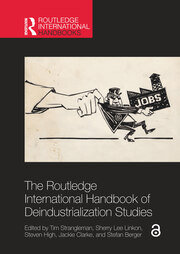
The Routledge International Handbook of Deindustrialization Studies
Introduction
Tim Strangleman, Sherry Lee Linkon, Steven High, Jackie Clarke, and Stefan Berger
Part I: Concepts and Theories
Introduction: Concepts and Theories
Tim Strangleman
1. Theorizing Deindustrialization
Steven High
2. Reflections on the Half-Life
Sherry Lee Linkon
3. Deindustrialization as Global History
Jim Tomlinson
4. Moral Economy and Industrial Culture
Andrew Perchard
5. Racializing Deindustrialization Studies
James Rhodes
Part II: Political Economy of Deindustrialization
Introduction: Political Economy of Deindustrialization
Steven High
6. Uneven Development, the World-system, and Lumpenization: Bringing Marxian Political Economy Back into Deindustrialization Studies
Fred Burrill and Matthew Penney
7. The Racial Dimensions of (De)industrialization
Jason Hackworth
8. The Region as an Analytical Framework for Deindustrialization Studies: Regional Economic Development in Atlantic Canada
Lachlan Mackinnon
9. Deindustrialization and Nationhood
Ewan Gibbs
10. Challenging and Politicizing Deindustrialization?
Marion Fontaine and Xavier Vigna
11. Anticipating Just Transitions: Ecological Crisis and Future Deindustrialization
Alice Mah
Part III: Communities, Identities, Affects
Introduction: Communities, Identities, Affects
Jackie Clarke
12. Community, Affect and Deindustrialization
Valerie Walkerdine
13. Deindustrialization and Racialized Communities: A Historical Perspective
Christopher Lawson
14. Class, Gender, and Industrial Structures of Feeling After Socialism: Post-industrial Lives in the Post-Yugoslav Space
Chiara Bonfiglioli
15. Metallic Vitalities: Smog, Steel and Stigma in a Deindustrial Town
Anoop Nayak
16. Deindustrialization, Leisure, and Feeling Communities
Julia Wambach
17. “Dad, Why Did You Bring Me to a Gay Steel Mill?” Notes Towards a Queer Study of Deindustrialization
Liam Devitt
Part IV: The Critical Cultural Work of Representations
Introduction: The Critical Cultural Work of Representations
Sherry Lee Linkon
18. Black Spatial Agency and Cultural Justice: Race, Ruins, and Gentrification in Detroit
Dora Apel
19. Uncovering the Discovery of the Ruhr: Representations of Deindustrialization in Germany’s Former Industrial Heartland
Helen Wagner
20. Making the Human Wreckage Visible: Deindustrialization in Kate Beaton’s Ducks
Peter Thompson
21. The Sound of Deindustrialization
Giacomo Bottà
22. Garment Workers Through the Lens of Loss: The Long Shadow of Deindustrialization in South Asian Films
Piyusha Chatterjee
Part V: Memories, Memorialization, and the Heritage of Deindustrialization
Introduction: Memories, Memorialization, and the Heritage of Deindustrialization
Stefan Berger
23. Industrial Memory Landscapes in Urban Planning Processes: Comparative Perspectives from Germany, Luxembourg, and France
Christa Reicher and Liliana Iuga
24. Memorialization of Industrial Pasts in Post-Socialist Countries
Juliane Tomann
25. The Memorialization of Class in Industrial Heritage Initiatives
Laurajane Smith
26. Uncovering Gender Tracks: Erasure and Railway Industrial Heritage Initiatives Across the World
Lucy Taksa
27. Industrial Heritage from the South: Decolonial Approaches to the Social Construction of Heritage and Preservation Practices
Marion Steiner
Conclusion
Tim Strangleman, Sherry Lee Linkon, Steven High, Jackie Clarke, and Stefan Berger
Biography
Tim Strangleman is Emeritus Professor of Sociology at the University of Kent, UK, where he is also Director of the Work, Employment and Economic Life research cluster. He has researched and published widely on issues of work, class, community, and deindustrialization. He has carried out work in the coal mining, rail, health, ship building, engineering, papermaking, and brewing industries, drawing on oral history, archives, and visual material. He is the author of Work Identity at the End of the Line? Privatisation and Culture Change in the UK Railway Industry (2004) and Voices of Guinness: An Oral History of the Park Royal Brewery (2019). He is also the co-author of Work and Society: Sociological Approaches, Themes and Methods (2008) and the co-editor of The Routledge Handbook of Working-Class Studies (2021). He is also a co-investigator on the Deindustrialization and the Politics of Our Time (DéPOT) project.
Sherry Lee Linkon is a Professor of English and American Studies at Georgetown University, USA, where, with campus and community colleagues, she developed the Steel Valley Voices digital archive of interviews and artifacts reflecting the experiences of 24 racial and ethnic groups in the Youngstown area. Her most recent book, The Half-Life of Deindustrialization (2018), examines early twenty-first century working-class narratives reflecting the continuing effects of economic restructuring in the US. With John Russo, she also co-authored Steeltown USA: Work and Memory in Youngstown (2002) and co-edited New Working Class Studies (2005). Her current research examines literature and photography reflecting Black women's perspectives on the legacies of deindustrialization. She is also a co-investigator on the Deindustrialization and the Politics of Our Time (DéPOT) project.
Steven High is Professor of History at Concordia University, Canada and Principal Investigator of the Deindustrialization and the Politics of Our Time (DéPOT) project. He has published extensively on the history and politics of deindustrialization in the US and Canada. His book, Industrial Sunset: The Making of North America’s Rust Belt (2003), won prizes from the American Historical Association and other organizations. He is also the author of Corporate Wasteland: The Landscape and Memory of Deindustrialization (with photographer David Lewis, 2007) and One Job Town: Work, Memory and Betrayal in Northern Ontario (2018), and the co-editor of The Deindustrialized World: Confronting Ruination in Postindustrial Places (2017).
Jackie Clarke is Senior Lecturer in French Studies at the University of Glasgow, UK, where she is also a member of the Centre for Gender History. She is also a co-investigator on the Deindustrialization and the Politics of Our Time (DéPOT) project. Her research explores questions about work, consumption, deindustrialization, and gender in contemporary France. She is the co-editor of a special issue on gender and deindustrialization in International Labor and Working Class Studies (2024).
Stefan Berger is Professor of Social History and Director of the Institute for Social Movements at Ruhr-Universität Bochum, Germany. He is also Executive Chair of the Foundation History of the Ruhr and an Honorary Professor at Cardiff University, UK. He is the author of History and Identity: How Historical Theory Shapes Historical Practice (2022) and editor of Constructing Industrial Pasts: Heritage, Historical Culture and Identity in Regions Undergoing Structural Economic Transformation (2020). He is a co-investigator on the Deindustrialization and the Politics of Our Time (DéPOT) project, an international partnership project funded by the Canadian Social Sciences and Humanities Research Council (SSHRC).
