



1st Edition
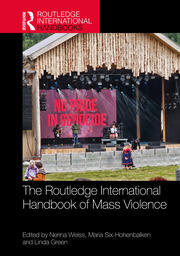
The Routledge International Handbook of Mass Violence
1. A Contemporary Critique of Mass Violence
Nerina Weiss, Maria Six-Hohenbalken, Linda Green
Section I: Theories of Mass Violence
2. The Snake - Trump’s White Genocide, Great Replacement Parable
Alex Hinton
3. Necropolitics: Mass Violence and European Mobility Regimes in the Mediterranean
Heidrun Friese
4. Four Hundred Years of Strategic Mass Violence: The European Conquest of North America
Kevin Bales and Christine Annerfalk
Section II: Strategies of Mass Violence
5. Landscapes of Disappearance
Sabrina Melenotte
6. A Brief History of Turkey's Mass Violence and Paramilitary Forces in Northern Kurdistan
Ayhan Işık
7. The Continuum of Mass Violence in Palestine/Israel: From Genocidal War to Street Shootings
Erella Grassiani
8. Distancing the Other: Theories of Mass Violence and their Applications to Exterminatory Genocides
Manus I. Midlarsky
Section III: Border Regimes
9. Migration and the Legacy of Social Violence in Central America
David Bacon
10. A Critical Forensic Anthropology of Low-Intensity Conflict at the US-Mexico border
Robin C. Reineke
11. Less-than-deadly Borders: Mass Injuries along the Balkan Route
Thom Davies, Jelena Obradovic-Wochnik, and Arshad Isakjee
12. Ghetto Laws in Denmark-An Analysis of State and Political Violence
Louise Victoria Johansen
Section IV: The Carceral System
13. The Mass Violence of Prison
Enrique Alan Olivares-Pelayo
14. The Gendered Harms of Mass Carceral Violence
Lindsey Raisa Feldman and Emily Selby Smith
15. Building Socialism through the Building of Prisons: Mass Violence and the Carceral System during the Cambodian Genocide
James A. Tyner
Section V: Ecology and Mass Violence
16. Extractivism
Eray Çaylı
17 Extractivism and Climate Change as Mass Violence: The Impact of Large-scale Industrial Development, Territory Fragmentation and Unstable Climate on Indigenous Homelands in Canada and Sápmi
Lena Gross
18. Win but not Win: The Paradox of Resistance and Violence Against Indigenous Communities in the Zapotec Mountains of Oaxaca, Mexico.
Salvador Aquino-Centeno
19. De-occupying as Planetary Politics: On the Damages of Russia's Full-scale Invasion of Ukraine
Adriana Petryna
Section VI: Legacies and Memories of Mass Violence
20. Human Remains and the Moral and Semiotic Limits of Mass Violence on Display in Cambodia
Carol Kidron
21. Memory of Mass Violence and the Subjunctive Space of Palestinianness
Leonardo Schiocchet
22. From Vietnam to Iraq: Empire’s Law, the People’s Court, Genocide and Delayed Justice
Fazil Moradi
23. Forging a Common Humanity: The Last 30 Years Since the Genocide Against the Tutsi in Rwanda in 1994
Alice Urusaro Uwagaga Karekezi and Stefanie Bognitz
Section VII: Justice and Reconciliation
24. International Criminal Justice and Victims’ Demand for Justice
Madoka Futamura
25. Legacies of Mass Violence: Indian Residential Schools in Canada
Kayla Boileau and Karine Vanthuyne
26. Human Security Law in Post-2003 Iraq: Deconstructing Transitional Criminal “Justice”
Hannibal Travis
27. Interdisciplinary Aspects of Dealing with Situations of Mass Violence
Thomas Wenzel, Jan Kizilhan, Reem Alksiri-Wenzel and Tatiana Urdaneta Wittek
Section VIII: Researching Mass Violence
28. What Noises Say About Mass Violence
Christian Gerlach
29. Slavery and Human Trafficking as Components of Mass Violence
Kevin Bales and Monti Narayan Datta
30. Collecting Testimonies in an Ongoing War: Precarity, Solidarity and the Glass Ceiling in International Academia
Diána Vonnák and Natalia Otrishchenko
Section IX – Afterword
31 Afterword
Hamit Bozarslan
Biography
Linda Green is a Professor of Anthropology at the University of Arizona. Her scholarship draws on insights garnered from over two decades of field-based research that has centered on multi-dimensional aspects of violence. Although her research is empirically, historically and geographically diverse, it centers on the ways in which experiences of power, violence and class, race/ethnic and gendered inequalities reshape ordinary peoples thinking and practices. More recently she has worked with incarcerated men to write a play “Inside out: Men Behind Bars” which was performed for a public audience at The Invisible Theatre in Tucson, Arizona.
Maria Six-Hohenbalken is Senior Researcher at the Institute for Social Anthropology, Austrian Academy of Sciences, and a lecturer at the Department for Social and Cultural Anthropology, University of Vienna. Her fields of interest are the Anthropology of Violence; Migration Studies; Refuge, Diaspora and Transnationalism; Memory Studies and Historical Anthropology. Her current project is on visual anthropology and arts-based participatory research in Kurdish transnational settings.
Nerina Weiss is Senior Researcher at Fafo Institute for Labour and Social Research in Oslo, Norway. She holds a PhD in Social Anthropology from the University of Oslo and has built her scholarship through extensive ethnographic fieldwork, particularly in Eastern Turkey, Cyprus, and Scandinavia. Her research centres on political violence, torture, and trauma, examined through the lens of citizen–state relations, migration, and practices of control and punishment. From 2011 to 2013 she was a Marie Curie Intra-European Fellow at DIGNITY – Danish Institute Against Torture, where she deepened her focus on the nexus between torture, trauma, and political subjectivities.
