





1st Edition
The Routledge Research Companion to the Works of Sor Juana Inés de la Cruz
Table of Contents
Introduction. Emilie L. Bergmann and Stacey Schlau
A Note About Conventions
I. Contexts
1. "The Empire and Mexico City: Religious, Political, and Social Institutions of a Transatlantic Enterprise." Alejandro Cañeque
2. "The Creole Intellectual Project: Creating the Baroque Archive." Yolanda Martínez-San Miguel
3. "The Gendering of Knowledge in New Spain: Enclosure, Women’s Education, and Writing." Stephanie Kirk
II. Reception History
4. "Seventeenth Century Dialogues: Transatlantic Readings of Sor Juana." Mónica Díaz
5. "Seventeenth-, Eighteenth-, and Nineteenth-Century Readings: Hagiography and Nationalism." Martha Lilia Tenorio
6. "Twentieth Century Readings: Schons, Pfandl, and Paz." Marie-Cécile Benassy-Berling
7. "Passionate Advocate: Sor Juana, Feminisms, and Sapphic Loves." Amanda Powell
8. "Translations of Sor Juana Inés de la Cruz: Ideology and Interpretation." Isabel Gómez
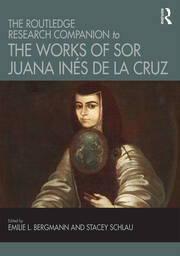
9. "’My original, a woman’: Copies, Origins, and Sor Juana’s Iconic Portraits." J. Vanessa Lyon
10. "Contemporary Mexican Sor Juanas: Artistic, Popular, and Scholarly." Emily Hind
III. Interpretations of and Debates about the Works
A. Prose Works
11. "The Afterlife of a Polemic: Conflicts and Discoveries Regarding Sor Juana’s Letters." Marie-Cécile Benassy-Berling
12. "Challenging Theological Authority: The Carta Atenagórica /Crisis de un sermón and the Respuesta a sor Filotea." Grady Wray
B. Verse
13. "Sor Juana’s Love Poetry: A Woman’s Voice in a Man’s Genre." Emilie L. Bergmann
14. "Sor Juana’s Romances: Between Fame, Contemplation, and Celebration." Rocío Quispe-Agnoli
15. "Philosophical Sonnets: Through a Baroque Lens." Luis Avilés
16. "Primero sueño: Heresy and Knowledge." Alessandra Luiselli.
C. Theater and Public Art
17. "Writing for the Public Eye: Theatrical Production, Church Spectacle, and State-Sponsored Art (The Neptuno alegórico)." Verónica Grossi
18. "Sor Juana as Lyricist and Musical Theorist." Mario Ortiz
19. "Loa to El Divino Narciso: The Costs of Critiquing the Conquest." Ivonne del Valle
20. "The Autos: Theology on Stage." Linda Egan
21. "Los empeños de una casa: Staging Gender." Susana Hernández Araico
22. "Recently Discovered Plays: La segunda Celestina and Amor es más laberinto." Guillermo Schmidhuber
IV. Future Directions for Research
23. "Understudied Aspects of Canonical Works and Potential Approaches to Little-Studied Works." George Antony Thomas
Works Cited
Biography
Emilie L. Bergmann is Professor of Spanish at the University of California, Berkeley, with fields of specialization in early modern Spain and Spanish America.
Stacey Schlau is Professor of Spanish and Women’s and Gender Studies at West Chester University of Pennsylvania.
