





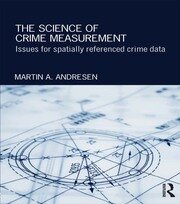
1st Edition
The Science of Crime Measurement Issues for Spatially-Referenced Crime Data
1. The science of crime measurement 2. Ambient populations and the calculation of crime rates and risk 3. The ambient population and crime analysis 4. Diurnal movements and the ambient population: an application to municipal level crime rate calculations 5. Measuring crime specialization: the location quotient 6. Crime specialization across the Canadian provinces and Metro Vancouver's municipalities 7. Location quotients, ambient populations and the spatial analysis of crime in Vancouver, Canada 8. The (in)appropriateness of aggregating across crime types 9. The spatial dimension of crime seasonality 10. Testing the stability of crime patterns: implications for theory and policy 11. Spatial heterogeneity in crime analysis 12. Future directions in the science of crime measurement.
Biography
Martin A. Andresen is an Associate Professor in the School of Criminology and Institute for Canadian Urban Research Studies at Simon Fraser University, Canada. His research interests include crime measurement, spatial crime analysis, environmental criminology, and the geography of crime. This research has been published in leading journals on both criminology and geography including: Applied Geography, British Journal of Criminology, Environment and Planning A, Journal of Research in Crime and Delinquency, and Urban Studies.
