




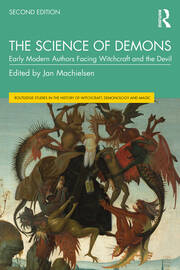
2nd Edition
The Science of Demons Early Modern Authors Facing Witchcraft and the Devil
Introduction: The science of demons
Jan Machielsen
Part I. Beginnings
1. The inquisitor’s demons: Nicolau Eymeric’s Directorium inquisitorum
Pau Castell Granados
2. Promoter of the sabbat and diabolical realism: Nicolas Jacquier’s Flagellum hereticorum fascinariorum
Martine Ostorero
Part II. The first wave of printed witchcraft texts
3. The bestselling demonologist: Heinrich Institoris’s Malleus maleficarum
Tamar Herzig
4. Lawyers versus inquisitors: Ponzinibio’s De lamiis and Spina’s De strigibus
Matteo Duni
5. The witch-hunting humanist: Gianfrancesco Pico della Mirandola’s Strix
Walter Stephens
Part III: The sixteenth-century debate
6. ‘Against the devil, the subtle and cunning enemy’: Johann Wier’s De praestigiis daemonum
Michaela Valente
7. The will to know and the unknowable: Jean Bodin’s De La Démonomanie
Virginia Krause
8. Doubt and demonology: Reginald Scot’s The Discoverie of Witchcraft
Philip C. Almond
9. Demonology and anti-demonology: Binsfeld’s De confessionibus and Loos’s De vera et falsa magia
Rita Voltmer
10. A royal witch theorist: James VI’s Daemonologie
P. G. Maxwell-Stuart
11. Demonology as textual scholarship: Martin Delrio’s Disquisitiones magicae
Jan Machielsen
Part IV: Demonology and theology
12. ‘Of ghostes and spirites walking by nyght’: Ludwig Lavater’s Von Gespänsten
Pierre Kapitaniak
13. A Spanish demonologist during the French Wars of Religion: Juan de Maldonado’s Traicté des anges et demons
Fabián Alejandro Campagne
14. Scourging demons with exorcism: Girolamo Menghi’s Flagellum daemonum
Guido Dall’Olio
15. The ambivalent demonologist: William Perkins’s Discourse of the Damned Art of Witchcraft
Leif Dixon
16. Piety and purification: The anonymous Czarownica powołana
Michael Ostling
Part V: Demonology and law
17. An untrustworthy reporter: Nicolas Remy’s Daemonolatreiae libri tres
Robin Briggs
18. The mythmaker of the sabbat: Pierre de Lancre’s Tableau de l’inconstance des mauvais anges et démons
Thibaut Maus de Rolley and Jan Machielsen
19. An expert lawyer and reluctant demonologist: Alonso de Salazar Frías, Spanish Inquisitor
Lu Ann Homza
Part VI: New foundations
20. Towards a science of witchcraft: Joseph Glanvill’s Saducismus triumphatus
Julie Davies
21. All good men: Cotton Mather's Wonders of the Invisible World
E. J. Kent
Epilogue: Endings
Jan Machielsen
Critical editions and English translations of demonological texts
Biography
Jan Machielsen is Reader in Early Modern History at Cardiff University with an interest in early modern witches, werewolves, and saints. His most recent book The Basque Witch-Hunt: A Secret History won the 2025 PROSE Award for European History.
Praise for the First Edition
Emily Cock presenting Jan Machielsen's The Science of Demons: Early Modern Authors Facing Witchcraft and the Devil - https://www.youtube.com/watch?v=0nVJ1iIpT2E
"This excellent collection of essays on demonology, from a team of leading scholars, can be firmly recommended. The book sweeps us from the medieval beginnings of demonology into the elaborate and Baroque imaginings of witches' sabbats in the early seventeenth century. Fearing witchcraft, writers on demonology created an intellectual system for combating the Devil and his witches as enemies of humankind. The demonologists revealed in this book are terrifyingly sincere - and we need to understand them better."
Julian Goodare, University of Edinburgh, UK"The Science of Demons is that rare hybrid: a significant scholarly contribution that is also good fun to read. The demonic realm emerges as a valuable companion to and dark mirror of the clear daylight world. Through examination of nineteen individual demonologists, the collection elaborates on what Stuart Clark calls "thinking with demons." Demons, it turns out, insinuated themselves into every cranny of early modern European thought, from theology to science to entertainment, and from skepticism to belief. They provided early modern thinkers with ways to think across and between disciplinary boundaries and categorical designation, and to resolve the major conundrums of their age. Featuring essays on well-known demonologists and lesser-known figures from peripheral regions, all presented in accessible and often witty form, the collection clarifies much about early modern European intellectual history."
Valerie Kivelson, University of Michigan, USA"This book brings together a remarkable group of experts to provide a panoramic survey of demonological literature. It is full of surprising insights and will be a standard work for years to come. A fitting tribute to Stuart Clark, it allows the reader to follow the development of the intellectual discussion of witchcraft and magic over time. An extraordinary achievement."
Lyndal Roper, University of Oxford, UK"This splendid volume takes Stuart Clark’s magisterial work on the ways to think with demons as a jumping off point for nineteen fascinating and carefully researched studies of individual works of demonology from the fourteenth to the early seventeenth centuries. These outstanding essays by leaders in the field explore the complex interaction of societal and personal pressures, latent scepticism and local belief, that brought this science of demons to the centre of religious, intellectual and political attention over these centuries, and will immediately become an important new foundation and resource for any endeavouring to understand the historical development of the European witch-hunt."
Charles Zika, The University of Melbourne, Australia"This is an extremely effective, expert, and wide-ranging introduction to the early modern “science of demons.” It will be a standard reference for scholars working in this area formany years to come."
Michael D. Bailey, Iowa State University, USA"While many of these intellectual biographies tell stories that will be familiar to experts in the field, they do so in a uniformly top-notch fashion. They are engaging, well written, and often highly entertaining. As such, this book will doubtlessly serve as a resource of the first instance for both scholars and students looking to make forays into the field for at least a generation to come. I highly recommend it."
Richard Raiswell, University of Prince Edward Island, Canada"Accessible, engaging, and profound, [The Science of Demons] offers a precise snapshot of the thought-world of early modern demonological authors …. [It] will soon be recognized as the standard scholarly work on early modern European demonology."
Brendan C. Walsh, The University of Queensland, Australia
