




1st Edition
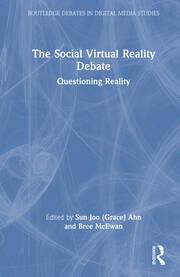
The Social Virtual Reality Debate Questioning Reality
List of Contributors
Introduction. Centering the Social in Immersive Spaces. Bree McEwan and Grace Ahn.
Chapter 1. Social VR: Playful, purposeful, or something else. Nicholas David Bowman, Kristine L. Nowak, Michael Nixon, Lynn Miller, Yoon Esther Lee, and Jih-Hsuan Tammy Lin.
Chapter 2. Social Relationships and Virtual Reality. Jesse Fox, Tilo Hartmann, and Matthew J. A. Craig.
Chapter 3. The Mixed Reality Realism/Authenticity Framework: An Organisational Structure for Research. Eugy Han, Benjamin J. Li, Rabrindra A. Ratan, and Heng Zhang.
Chapter 4. Debating the Digital Divide in the Age of Extended Realities: Who Is (and Isn’t) Ready for an Immersive Future? Christopher Ball, Kuo-Ting Huang, Joomie Li, and Chaeyun Lim.
Chapter 5. Why Not on Zoom? Replacing or Integrating Technologies with Collaborative XR. Diego Gomez- Zara.
Chapter 6. Should Social XR Always be Immersive? Eugene Kukshinov
Chapter 7. Virtual Reality and Pedagogy: Beyond the Hype. Michelle Lui
Chapter 8. Virtual Reality, Real Bias: Fostering Inclusivity in Virtual Worlds. Breigha Adeymo, Maxwell McGee, Andrea Stevenson Won, Danny Pimentel
Index
Biography
Sun Joo (Grace) Ahn is a Professor at the Grady College of Journalism and Mass Communication, University of Georgia, USA, and founding director of its Center for Advanced Computer-Human Ecosystems (CACHE). Her research investigates how immersive technologies such as virtual and augmented reality transform traditional rules of communication and social interactions, looking at how virtual experiences shape the way that people think, feel, and behave in the physical world.
Bree McEwan is a Professor of Mediated Communication in the Institute for Communication, Culture, Information and Technology at the University of Toronto Mississauga, Canada. She is also associate director of the University of Toronto Data Sciences Institute and director of the McEwan Mediated Communication Lab. Her research focuses on how the affordances of mediated technologies influence human communication processes and social interaction.
