





1st Edition
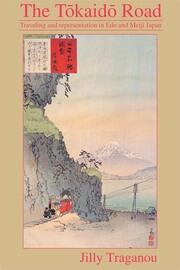
The Tôkaidô Road Travelling and Representation in Edo and Meiji Japan
By Jilly Traganou
Copyright 2004
288 Pages
by
Routledge
304 Pages
by
Routledge
304 Pages
by
Routledge
Also available as eBook on:
The Tôkaidô Road offers a comparative study of the Tôkaidô road's representations during the Edo (1600-1868) and Meiji (1868-1912) eras. Throughout the Edo era, the Tôkaidô highway was the most important route of Japan and transportation was confined to foot travel. In 1889, the Tôkaidô Railway was established, at first paralleling and eventually almost eliminating the use of the highway. During... Read more
List of figures Acknowledgements Glossary 1. Introduction 2. Infrastructure and Cartography of the Tôkaidô in Macro 2.1. The Tôkaidô as a Geopolitical Territory 2.2. Infrastructure upon the Tôkaidô Route 2.3. The Tôkaidô's Cartography 3. Travelling Practices and Literary Tôkaidô 3.1. Road Cosmology - The Road as a Microcosm 3.2. Travelling Practices of the Edo Period 3.3. Literary Tôkaidô 4. Performance, Visuality and Imagination at the Tôkaidô's Micro-Scale 4.1. Transportation-Stations: Spaces of Performance, Spaces of Representation 4.2. Tôkaidô and Visuality 5. Conclusions and Openings: The Tôkaidô as Medium of National Knowledge 5.1. National Knowledge and Epistemology 5.2. History as Nostalgia, History as Play Bibliography Notes
Biography
Jilly Traganou currently teaches Architecture at the University of Texas. She has contributed to Japanese Capitals and Suburbanizing the Masses.
'Of great value for those interested in the history of traveling in Japan, and more specifically of traveling along the Tôkaidô.' - Society for Japanese Arts Newsletter
'What Treganou gives is a compendium of the culture andhistory of the Tôkaidô in the seventeenth to nineteenth centuries. It is a helpful work that will encourage serious thinking about the range of issues it covers.' - Journal of School of Oriental and African Studies
