



1st Edition
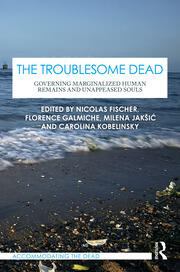
The Troublesome Dead Governing Marginalized Human Remains and Unappeased Souls
Introduction: Meeting the Troublesome Dead
Nicolas Fischer, Florence Galmiche, Milena Jakšić and Carolina Kobelinsky
Part I: Languages of Remains
1. Rembering Robert Hertz: From the Korean War Forensic Field.
Heonik Kwon
2. Cuelgamuros: Troublesome Dead in a Dissonant Monument.
Francisco Ferrándiz
3. Memories and Heritage Designation of Human Remains from Massacres: Case Studies (Belchite, Oradour-sur-Glane, Distomo).
Stéphane Michonneau
4. Dead Man Talking: Medical Expertise in a US Trial Over Executions by Lethal Injection.
Nicolas Fischer
Part II: Sensing the Dead
5. Ghostly Influences: Interpreting the Troublesome Dead in Northern Uganda.
Tim Allen
6. Memories of the Flesh, Kinships of the Soul: Reincarnation, Druze Identity and the Memory of the Lebanese Civil War (1975- 1991).
Malek Rasamny
7. Repatriation and Reconciliation: Korean Victims of Forced Labor in Japan and the Coming Home After Seventy Years.
Chung Byung-Ho
8. Sensing the Wandering Dead: Resonances Between Korean Forced-Workers and African Border-Crossers.
Florence Galmiche and Carolina Kobelinsky
Part III: Political Struggles over the Dead
9. Spirits in the Court: Spiritual Constraints and Military Strategy in the Dominic Ongwen Trial.
Milena Jakšić
10. Covid and Critical Movement in French Caribbean Families: Dealing with the Pandemic Dead, Transforming Republican Citizenship.
Linda Haapajärvi
11. Otherness in local cemeteries: Muslim burial grounds in France and Britain during and after the COVID-19 Pandemic.
Nada Afiouni
12. From Pit to Grave: Handling of the Dead and Social Conflict After the Courrières Mine Disaster (1906).
Anne Carol
13. The Troublesome (In)visibility of Famine Death.
Naomi Pendle et al.
Afterword: Two Boys and the Thought of the Earth
Erik Mueggler
Biography
Nicolas Fischer is a CNRS Research Fellow in Political Science at the Centre for Legal and Penal Institutions Sociology (CESDIP). His main research interest is the tension between violent repression and legal protection of stigmatized populations in democracies His recent research has dealt with immigration detention in France, issues of Human Rights within penal detention facilities, and the current litigation against judicial executions In the United States.
Florence Galmiche is an associate professor at the Université Paris Cité, a member of the Centre for Studies on China, Korea and Japan (EHESS-CNRS-UPCité), and a junior member of the Academic Institute of France (IUF). Her research in Anthropology focuses on Korea and is based on the contemporary practices of Buddhism and the relations between the living and the dead.
Milena Jakšić is a CNRS Research Fellow in Sociology at the Centre d’études des mouvements sociaux (EHESS, Paris). Several of her publications focus on human trafficking, migration, sex work, and child soldiers. Her most recent work develops an ethnography of the International Criminal Court and its practices of witnessing, justice, and international intervention. Her latest publication is Juger malgré tout. Ethnographie de la Cour pénale internationale (Judging Despite Everything: An Ethnography of the International Criminal Court, CNRS Éditions, 2026).
Carolina Kobelinsky is CNRS researcher fellow in Anthropology at the Laboratory of Ethnology and Comparative Sociology, University of Paris Nanterre. Her current research deals with the material and symbolic treatment of dead and disappeared border-crosser en route to Europe.
