





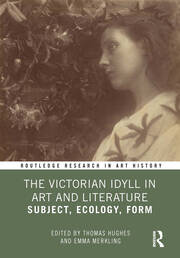
1st Edition
The Victorian Idyll in Art and Literature Subject, Ecology, Form
Foreword
Caroline Arscott and Clare Pettitt
Introduction
Thomas Hughes and Emma Merkling
1. Idyll as Refuge: The Settler’s Dream
Charlotte Cary-Beckett and Josephine McDonagh
2. ‘Cutting So “Sweetly”’: Idyllist Wood Engravings and the Lost Boxwood Forests
Bethan Stevens
3. Multicolour as Disavowal: The Racial Politics of the Nineteenth-Century Idyll
Caroline Arscott and Clare Pettitt
4. John Addington Symonds’s Theocritus and the Homoerotic Idyll in Sicily
Daniel Orrells
5. Ancient and Modern: Attention and Environmental Change in the Victorian Pictorial Idyll
Kate Flint
6. Queer Pastoral Soundscapes and the Idyllic Voice: Vernon Lee, A. Mary F. Robinson, and Lady Archibald Campbell
Fraser Riddell
7. Plant Subjects, Plant Erotics: Julia Margaret Cameron’s Creeping Idyll
Emma Merkling
8. Wondrous Transformation in Dante Gabriel Rossetti’s La Ghirlandata
Thomas Hughes
Biography
Thomas Hughes is an art historian who has published on John Ruskin, Victorian art, ecology and temporality.
Emma Merkling is Rome Fellow at the Paul Mellon Centre for Studies in British Art, and Deputy Associate Director of Research at the Centre for Nineteenth-Century Studies International at Durham University.
"As though startling us from a dream or waking us from a too-peaceful slumber, the editors of this bracing new collection have turned a topic we thought we knew into a set of problems sharply relevant now. Across a gorgeous range of artworks and literary texts, the essays gathered in this bracing new collection tune us in to the idyll’s haunted signaling power, showing how the seemingly inert or apparently passive gives broken testimony to a world in crisis. Timely, provocative, and precise, The Victorian Idyll in Art and Literature recovers the idyllic as an aesthetic category for uneasy times."
--Nathan K. Hensley, Georgetown University
"Radical, experimental, political, provocative — these are not terms typically associated with the seemingly genteel, idealising pictures and verses known as idylls that seem so ineluctably Victorian. Contributors demonstrate that, quietly and often obliquely, the apparently backward-looking idyll was profoundly engaged with modernity: with ecological issues, questions of race and empire, sexuality and gender identity. This is a volume that recalibrates the scene of Victorian culture."
--Hilary Fraser, Emerita Geoffrey Tillotson Chair of Nineteenth-Century Studies, Birkbeck, University of London
