




1st Edition
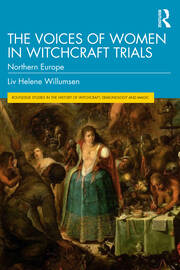
The Voices of Women in Witchcraft Trials Northern Europe
1. Introduction 2. Spanish Netherlands – Holy Water, Witchcraft Powder, and the Collar 3. Northern Germany – Bloksberg, Red Rider, and Torture ‘in a humane way’ 4. Denmark – Weather Magic, Witches’ Dance, and Personal Demons 5. Scotland – Devil’s Pact, Gatherings, and Sleep Deprivation 6. England – Familiars, Teats, and Witchfinders 7. Norway – Charms, Blåkoll, and Chasing Fish 8. Sweden – Kullen, Blåkulla, and the Water Man 9. Finland – Magic Salt, Uncovered Hair, and Blåkulla 10. Comparison and Conclusion
Biography
Liv Helene Willumsen is Professor Emerita of History, University of Tromsø (UiT - The Arctic University of Norway). PhD in History (Edinburgh, 2008). PhD in literature (Bergen, 2003). Her books include Witches of the North: Scotland and Finnmark (Leiden, 2013). She has written the exhibition texts of Steilneset Memorial, Vardø. She was awarded the Norwegian King’s Medal of Merit in 2019.
‘A compelling study of women’s words in witchcraft trials across many countries located around the North Sea, it provides different methodological approaches and a transnational regard, giving valuable insight into the field of mentalities. Not only the voices of the accused come alive, but also those of the judges, the scribes, the witnesses, and all those involved in a large number of trials carefully chosen by the author.’
Marina Montesano, University of Messina, Italy
‘The volume offers a useful model for using classical narratology in history and the history of witchcraft in general, backed up by a variety of sample analysis from various parts of Europe. The methodology is used to analyse questions of gender and agency, but it will be useful for scholars of various other perspectives on the history of witchcraft, too, including topics such as transfer of knowledge, creation of opinions, controlling of emotion and deconstruction of persecutions.’
Raisa Maria Toivo, Tampere University, Finland
