




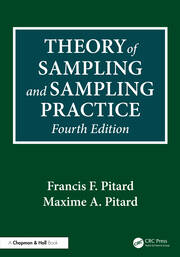
4th Edition
Theory of Sampling and Sampling Practice
Chapter 1: Definition of Basic Terms and Symbols
Chapter 2: A Management Strategy
Chapter 3: Fundamental Statistical Concepts
Chapter 4: Introduction to the Components of the Overall Estimation Error
Chapter 5: A Logical Introduction to the Notion of Heterogeneity
Chapter 6: Heterogeneity of a Zero-Dimensional Lot: Constitution and Distribution Heterogeneities
Chapter 7: Heterogeneity of a One-Dimensional Lot: Notion of Variography
Chapter 8: Sampling of One-Dimensional Lots: The Continuous Model
Chapter 9: Sampling of Zero-Dimensional Lots: The Discrete Model.
Chapter 10: The Fundamental Sampling Error
Chapter 11: Minimizing the Fundamental Sampling Error in Sampling Protocols
Chapter 12: Other Approaches, a Strategy, and Cardinal Rules for the Estimation of the Variance of FSE
Chapter 13: The Grouping and Segregation Error
Chapter 14: The Works of Visman and Ingamells Relevant to the Theory of Sampling
Chapter 15: Theoretical, Practical, and Economic Difficulties in Sampling for Trace Constituents
Chapter 16: From Links between Gy and Ingamells to a Sampling Strategy
Chapter 17: The In-Situ Nugget Effect: A Transition Between Geostatistics and the Theory of Sampling
Chapter 18: The Increment Materialization Error
Chapter 19: Sampling Modes
Chapter 20: The Increment Delimitation Error during Exploration, Mining, and Sampling Food and the Environment
Chapter 21: The Increment Delimitation Error at a Processing Plant
Chapter 22: The Increment Delimitation Error during Sampling at the Laboratory
Chapter 23: The Increment Extraction Error during Exploration and Mining
Chapter 24: The Increment Extraction Error during Sampling in a Processing Plant
Chapter 25: The Increment Extraction Error during Sampling at the Laboratory
Chapter 26: The Increment Preparation Errors and the Notion of Sample Integrity
Chapter 27: The Increment Weighting Error
Chapter 28: The Weighing Error
Chapter 29: Sampling for the Determination of the Moisture Content
Chapter 30: Peculiarities about the Sampling of Precious Metals
Chapter 31: Sampling of Liquid and Solid Wastes and Sampling of the Environment
Chapter 32: Solvable and Unsolvable Sampling Problems
Chapter 33: A Strategy to Take Better Advantage of Existing Chronological Data
Chapter 34: The Use of the Variogram to Elaborate Meaningful Process Control Charts
Chapter 35: Case Studies where Variography is an Effective Tool to Discover and Quantify Structural Problems
Chapter 36: An Introduction to Homogenizing Processes.
Chapter 37: Bed-Blending Techniques
Chapter 38: Recommendations for the Design, Installation and Maintenance of Sampling Systems
Chapter 39: Introduction to Variography - Notions of Variability and Derivation
Chapter 40: Bias Testing - Bias Test Visualization using Pierre Gy’s Approach
Biography
Dr. Francis F. Pitard is a consulting expert in Sampling, Statistical Process Control (SPC) and Total Quality Management (TQM). He is President of Francis Pitard Sampling Consultants (www.fpscsampling.com) and Technical Director of Mineral Stats Inc. (MSI) in Broomfield, Colorado, USA. He provides consulting services in many countries. Dr. Pitard has six years of experience with the French Atomic Energy Commission and fifteen years with Amax Extractive R&D. He taught Sampling Theory, SPC, and TQM for the Continuing Education Offices of the Colorado School of Mines, the Australian Mineral Foundation, for the Mining Department of the University of Chile, and the University of Witwatersrand in South Africa. He has a Doctorate in Technologies from Aalborg University in Denmark. He is the author of 36 papers published over the last 40 years. He has an outstanding expertise in all aspects of sampling accumulated during a 20-year association with C.O. Ingamells and Dr. Pierre M. Gy. He coauthored “Applied Geochemical Analysis”. C.O. Ingamells and F.F. Pitard. Wiley Interscience Division, John Wiley and Sons, Inc., New York, 1986. 733 pages textbook. He published two historical novels analyzing the origins of the Easter Island people. Dr. Pitard lived for a total of 6 years in the South Pacific and had a strong interest in Polynesian archeology and philosophy. “Heirs of a Lost Race”, 2001 ISBN: 0-7596-9472-9, Published by AuthorHouse “Rapa Nui Settlers – by choice and necessity”, 2009, Published by AuthorHouse. ISBN: 978-1-4389-5158-4 (e) ISBN: 978-1-4389-2940-8 (sc) ISBN: 978-1-4389-2942-2 (hc) Dr Pitard published a biography of a French Resistance hero. “From Normandy to the Hell of Ravensbruck: Life and escape from a concentration camp – The true story of 44667.” The true story of Dr. Pitard’s great aunt during WWII. Page Publishing, Inc. 2016 ISBN 978-1-68348-728-9 (Paperback) ISBN 978-1-68348-729-6 (Digital) He is the author of an essay on Nuclear Physics, titled “The Theory of Vacuoles and Low-Energy Nuclear Reactions”, 2017. http://mediahead.ca/Francis_Pitard_LENR/ Dr. Pitard doctoral thesis, Pierre Gy’s Theory of Sampling and C.O. Ingamells’ Poisson Process Approach, pathways to representative sampling and appropriate industrial standards, Aalborg University, campus Esbjerg, Niels Bohrs Vej 8, DK-67 Esbjerg, Denmark, 2009.
Maxime A. Pitard is the founder of HonuaTek LLC, a company focused on developing digital solutions for the mining, manufacturing and utilities industries. He holds a B.Sc. in Mathematics and Computer Science from the Colorado School of Mines and has over 30 years of experience in IT consulting where he has engaged customers ranging from small technology startups to fortune 50 organizations. His exposure to the Theory of Sampling (TOS) started in the early 1980’s, where he authored software to implement many of the compute intensive concepts described in this book. Mr. Pitard started his career as a chemist/scientist in commercial analytical laboratories, working his way into management positions, eventually joining an international consulting firm where he gained experience with large organizations navigating their digital journeys. In parallel, Mr. Pitard continued to author sampling software, and over the years has taken a more active role in sampling consulting, providing training on both the software and certain aspects of the TOS.
