





186 Pages
by
Routledge
186 Pages
by
Routledge
186 Pages
by
Routledge
Also available as eBook on:
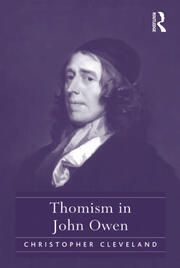
Examining the influence of Thomas Aquinas and his followers upon the seventeenth century Puritan theologian John Owen, this book breaks new ground in exploring the impact of medieval thought upon Reformed scholasticism. Cleveland argues that Owen uses Thomistic ideas in two ways: first in an Augustinian fashion arguing against Pelagian and semi-Pelagian ideas of human independency; second in a... Read more
Contents: Introduction; The Thomistic concept of God as pure act in John Owen; The Thomistic concept of infused habits in John Owen: Part I; The Thomistic concept of infused habits of grace in John Owen: Part II; Thomism in the Christology of John Owen; Conclusion: a Western Trinitarian theology; Bibliography and further reading; Index.
Biography
Christopher Cleveland received his Ph.D. from the University of Aberdeen, where he studied with Professor John Webster on the topic of Thomism in John Owen. Previously, he studied at Westminster Seminary (M.A.R.) and Boyce College (B.A.). This is his first book.
’With exemplary clarity, patience and erudition, this illuminating study demonstrates how much Owen shares with the theological and spiritual culture of Thomas and his followers.’ John Webster, University of Aberdeen, UK ’During the last fifty years, scholars of the sixteenth and seventeenth centuries have sought to transcend the old ecclesiastical paradigms of historical theology in order to understand how much cross-fertilisation took place in the early modern period between Protestant and Catholic thinkers. In this book, the author has done good work in demonstrating the deeply Thomistic roots of that most Protestant of theologians, John Owen. A good contribution to the growing literature in the field.’ Carl Trueman, Westminster Theological Seminary, USA ’...Thomism in John Owen breaks new ground and is a worthy contribution to Reformed-Thomist studies. Cleveland’s book especially highlights the prominent role Thomas had among the Reformed and his book shows that there was not as radical a break between Protestants and Romanists, especially on the doctrine of God, in the seventeenth century as the period’s polemics might suggest. In this sense Thomism in John Owen is as significant a book as Arvin Vos’s Aquinas, Calvin, and Contemporary Protestant Thought (1985)...’ Westminster Theological Journal ’...this volume unapologetically highlights an amazing level of continuity, further demonstrating the inherent Catholic nature of leading seventeenth-century Protestant theologians, even amid their developments.’ Journal of Theological Studies
