




1st Edition
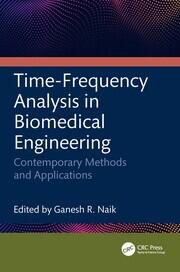
Time-Frequency Analysis in Biomedical Engineering Contemporary Methods and Applications
SECTION I. Introduction to Time-Frequency Analysis for Biomedical Engineering
Chapter 1: Wavelet-Based Biomedical Signal Analysis: A Tutorial Approach for Pathological Assessment
Gabriel José Pellisser Dalalana, Alex Marino Gonçalves de Almeida, and Rodrigo Capobianco Guido
ISECTION II. Time-Frequency Analysis of Specific Biomedical Signals
Chapter 2: Time-Frequency Analysis of ECG Signal
Divya Jain, Vibha Tiwari, Akshra Tiwari, and Suyash Khare
Chapter 3: Application of Decomposition Techniques to Physiological Time Series with Variable Spectral Content Adil Deniz Duru and Hasan Birol Çotuk
SECTION III. Applications in Neurological Signal Processing
Chapter 4: Denoising of Single-Channel EEG Signals Using Wavelet Transform with the Krawtchouk Functions
Natalia Filimonova, Mykola Makarchuk, and Elfriede Friedmann
Chapter 5: Optimized Feature Selection and Neural Network-Based Classification of Motor Imagery Using EEG Signals: A Time-Frequency Approach
Muhammad Sudipto Siam Dip, Mohammod Abdul Motin, Md. Anik Hasan, and Sumaiya Kabir
Chapter 6: Electroencephalogram-Based Driver Drowsiness Detection Using Entropy Features with Lightweight Deep Learning Model
Md. Anik Hasan, Mohammod Abdul Motin, Muhammad Sudipto Siam Dip, and G. K. M. Hasanuzzaman
SECTION IV. Seizure Detection and Classification Using Time-Frequency Features
Chapter 7: From Signals to Automated System: Seizure Detection Using Time-Frequency EEG Features: An Experimental Investigation
Abhishek Sathyendran, Ankith P. Shetty, Roopa B. Hegde, and G. R. Pradyumna
Chapter 8: Deep Learning-Based Epileptic Seizure Classification in Neonates Using STFT-Transformed EEG Signals
Saif Al-Jumaili, Salam Alyassri, Ahmed A. Mohammed, Adil Deniz Duru, and Osman Nuri Uçan
Chapter 9: E-PRESTO: Epileptic Preictal State Detection Using Time Series Modelling
Priya Shree, Manvir Bhatia, Tapan Kumar Gandhi, and Piyush Swami
Chapter 10: Sliding Window-Based Epileptic Seizure Detection Using Classifier Fusion and TQWT with Statistical Features
Durga Siva Teja Behara, Anirudh Kumar, Manvir Bhatia, Tapan Kumar Gandhi, Bijaya Ketan Panigrahi, and Piyush Swami
SECTION V. Advanced Techniques and Machine Learning Applications
Chapter 11: Arrhythmia Detection Using WPD with Bagging and Boosting Ensemble Machine Learning Methods
Abdulhamit Subasi, Muhammed Enes Subasi, and Saeed Mian Qaisar
Chapter 12: EEG-based Biometric Authentication Using Wavelet Packet Decomposition and Ensemble Classifiers
Abdulhamit Subasi, Muhammed Enes Subasi, and Saeed Mian Qaisar
Biography
Ganesh R. Naik is a globally recognized biomedical engineer and signal processing expert, ranked in the top 2% of researchers by Stanford University. He holds a PhD from RMIT University and is currently a senior academic at Torrens University Australia. A prolific researcher, he has edited 16 books and authored over 150 papers. Dr. Naik is an associate editor for several prestigious journals, including IEEE ACCESS. His career includes significant research roles at Flinders University, Western Sydney University, and the University of Technology Sydney, where he contributed to advancements in sleep health and wearable technologies. He has received numerous fellowships, including from the Royal Academy of Engineering UK, the Government of Australia, and Germany's Baden–Württemberg Scholarship.
