





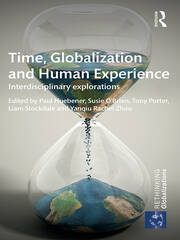
1st Edition
Time, Globalization and Human Experience Interdisciplinary Explorations
1. Introduction
[Paul Huebener, Susie O'Brien, Tony Porter, Liam Stockdale, and Yanqiu Rachel Zhou]
2. Time and Sovereignty in the Neoliberal Global Hegemony
[Robert Hassan]
3. Time, Worker Exploitation and Global Capitalism
[Wayne Hope]
4. Closing the Loop on Financialization and Scenario Planning
[Simon Orpana]
5. Imagined Futures and Exceptional Presents: A Conceptual Critique of Preemptive Security]
[Liam Stockdale]
6. While the West Sleeps
[Kevin Birth]
7. Accelerated contagion and response: Understanding the relationships among globalization, time, and disease
[Yanqiu Rachel Zhou and William D. Coleman]
8. The Inertia of Energy: Pipelines and Temporal Politics
[Brent Ryan Bellamy]
9. Yugoslavism: History, Temporality, and the Search for Alternative Modes of Political Critique
[Petra Rethmann]
10. The Rhythms of the Global
[Adam Barrows]
11. Checked Baggage: An Afterward for Time and Globalization
[Sarah Sharma]
Biography
Paul Huebener is an Assistant Professor of English in the Centre for Humanities at Athabasca University, Canada.
Susie O’Brien is an Associate Professor in the Department of English and Cultural Studies at McMaster University, Canada.
Tony Porter is Professor of Political Science, McMaster University, Canada.
Liam Stockdale is a Postdoctoral Fellow at the Paul R. MacPherson Institute for Leadership, Innovation and Excellence in Teaching at McMaster University, Canada.
Yanqiu Rachel Zhou is an Associate Professor at the Institute on Globalization and the Human Condition and the School of Social Work, McMaster University, Canada.
'This vibrant collection provides a nuanced, multifaceted exploration of the intricacies of the temporal and the global, especially in relation to human imagination and sociality. A must for scholars from across the disciplines interested in processes and practices connected to globalization.' — Imre Szeman, Canada Research Chair in Cultural Studies, University of Alberta, Canada
'Because it opens up and deepens the ways we can think critically of time and temporality – and shows why doing so is more urgent than ever - this volume is essential reading.' - Robert Latham, York University, Toronto, Canada
