





1st Edition
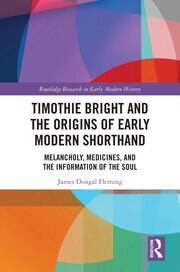
Timothie Bright and the Origins of Early Modern Shorthand Melancholy, Medicines, and the Information of the Soul
Introduction
The Double physician
Informatio medici
Messages and meanings
From hand to soul
Part One: Technology
1. The Seventeenth-Century Shorthand Movement: In Four Corners
A Protean art
Yet shorter
Groovy images
Another way to the word
2. “My Invention”: What Was Characterie?
Verbatim notation
Informational exchange
Hybrid publishing
Innovation
Source
3. “Indifferently Affected”: The Characterie Terms
Wanting an alphabet
De arte combinatoria
A Book of lists
Writing sermons
Orality and control
Mere information
Part Two: Theory
4. Against Navigation: English Medicines
The Medical background, ca. 1580
An English Galenism, 1574
The Paracelsian difference, 1585
TEM (i) Aut externi orbis
(ii) Here be (no) serpents
5. “Never Able to Abide”: The Melancholy Conscience
The Medical Tradition: Natural, genial, adust
The Literary Valence: Euphues his face
Treatment: Going on a data
TMel (i) “Saving that”
(ii) “No medicine, no purgation, no cordial”
(iii) “Spectacles are to be shunned”
(iv) “In written words revealed”
6. “The Mechenist”: Not Being There
TMel (v) The Natural chemist
(vi) Invisible seeds
(vii) Bright’s spirit
(viii) Faculty and instruments
(ix) In machina
(x) Serenity of the spotless psyche
(xi) Information overload
Conclusion
Appendices
1. Sixteenth-Century English shorthands before Bright’s? The absence of evidence.
2. Lists of the Characterie terms.
3. Bright on “soul” and “mind.”
Bibliography
Biography
James Dougal Fleming is Professor of English Literature at Simon Fraser University in Vancouver, Canada. His research is primarily in early modern intellectual history, with an emphasis on epistemic issues surrounding, and arising from, the Scientific Revolution. His previous books are Milton’s Secrecy and Philosophical Hermeneutics (2008), The Mirror of Information in Early Modern England: John Wilkins and the Universal Character (2017), and (ed. and intro.) The Invention of Discovery, 1500–1700 (2011).
