




1st Edition
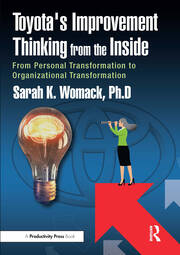
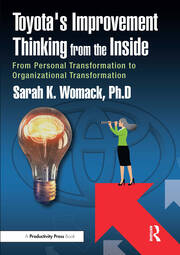
Toyota's Improvement Thinking from the Inside From Personal Transformation to Organizational Transformation
Preface
About the Author
Chapter 1 – The TPS way to personal and organizational transformation
· Onboarding Part 1 - standardized work kaizen training
· Onboarding Part 2 - two weeks on the production line
o TWI Training Way and team leader
o Team relations
o My Body
· Onboarding Part 3 – Standardized work “Try on Own”
· The change point: double consciousness and values
· The transformation model
· Sharing the good news
Chapter 2 – Technical systems, values, and a culture of improvement
· Stability vs muda
· Jidoka (integrating quality and productivity)
· Just-in-time
· Continuous flow and takt time
· Pull System (like a supermarket)
· Heijunka
· Standardization
· Safety and safe process design in transformation
· Ergonomics in daily management
· Kaizen
· Problem Solving
· Culture and transformational values
o Work setting
o Organization structure and ways
o Improvement
o Discipline
o Teamwork
o Communication
· Culture and the transformation model
Chapter 3: Problem-solving – Oh, the places you’ll go
· Paint shop process
· Problem solving in jishuken
o Step1: Clarify the problem (ultimate goal and the gap)
o Step 2: Break down the problem (narrow breadth, prioritize, go deep)
o Step 3: Target Setting
o Step 4: Root cause analysis
o Step 5 & 6: Develop and implement countermeasures
o Steps 7 & 8: Monitor the results/processes & Standardize
o Storytelling: The Report-Out
· Conclusion
Chapter 4: Continuous improvement (C.I.) implementation in other organizations (manufacturing, healthcare, education)
· A. C.I. in manufacturing - creation of a continuous improvement model
o Production control will level (heijunka) incoming customer orders
o Pull system to manage production and stores
o Processes and conveyance have standardized work
o Daily management and living the values
o From ideal to just-do-it
o Problem Solving
o Results
o Reflections
· B. C.I. implementation in healthcare
o Contemporary view of improvement in healthcare
o Traditional hospital culture and the transformational values
o Clarify the business/customer need
o Grasp the initial condition
o Ideal condition and plan
o Just do it and results
o Reflections
o Standardization
· C. C.I. implementation in education
o A framework for quality improvement in education
o Continuous improvement thinking applied in K-12 education
§ Clarify the gap
§ Break down the problem
§ Target setting and root cause
§ Countermeasure
§ Results
§ Yokoten (Spread) the results
Conclusion
Appendix
References
Biography
Sarah K. Womack is a distinguished researcher and consultant in the field of Industrial Engineering. Her Ph.D. in the department of Industrial & Operations Engineering from the University of Michigan, Ann Arbor focused on the intersection of lean manufacturing practices and ergonomics. She has published peer-reviewed articles, presented as guest speaker at conferences and universities, and facilitated copious workshops on lean manufacturing. She has established herself as a leading scholar and consultant of one of the world’s most coveted management systems, the Toyota Production System. She spent eight years on a journey in various leadership roles of "learning by doing" under some of the world’s greatest lean thinkers at Toyota. Applying Toyota’s management thinking, she consults across an array of industries with an innovative and practical approach to continuous improvement, organizational transformation, and operational excellence - coaching at every level from the C-suite to the shopfloor. She continues to learn and collect a patchwork of stories to teach and inspire others on their operational excellence journeys. In addition to her writing, consulting, and speaking engagements, Sarah is passionate about traveling the world and immersing herself in diverse cultures.
We are fortunate to have this book to learn about “Toyota’s Improvement Thinking from the Inside.” It is one thing to have lived it and something entirely different to be able to capture in words the journey, the feeling, and the essence. Somehow Sarah has managed to do this and give you that insider’s view and feel. It is very different from sterile courses on Lean Six Sigma management. It is in many ways the essence of humanity striving toward perfection, yet realizing it is always out of reach.
-- Jeffrey K. Liker, Author of The Toyota Way and Professor Emeritus, Industrial and Operations Engineering, University of Michigan
