





1st Edition
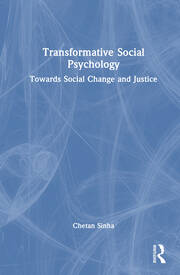
Transformative Social Psychology Towards Social Change and Justice
Introduction Part I: In Search of Transformative Social Psychology 1. Towards transformative social psychology in India 2. Reimagining interdisciplinarity and the idea of global Part II: Developing Social Psychology for Social Justice 3. Developing social psychology for social justice: Reflection on methodology and theory 4. Data and social justice 5. Is decolonizing social psychology transformative? Part III: Social Psychology as Activism 6. Doing critical social psychology in India 7. Gatekeeping social psychology: Agenda for social justice and social change Concluding remarks
Biography
Chetan Sinha is a psychology professor at Jindal Global Law School, OP Jindal Global University, India. He authored The Power Dynamics of Education: Shaping the Structure of School Education in India (2023). He writes on the psychology of power applied to different psychological domains, emphasizing social representations, social identity, and critical pedagogy.
"Sinha has written an important overview and analysis of modern social psychology in India. He leads the reader through the reception of Western social psychology in India and the effort to integrate it with the traditional social psychology already extant in the country. His work is critical, activist, and decolonizing as it follows a social justice orientation. Sinha has delivered a vital text for all who care about social psychology and its implications and applications to contemporary India and the larger world of social science."
Wade E. Pickren, PhD, Independent Scholar
"Transformative Social Psychology is a long-awaited innovative breakthrough in a field that has been stagnating in the last half century. Its author offers a new paradigm for the discipline that critically and constructively re-builds the field, allowing the complexities of our contemporary societies to be understood in a new way."
Jaan Valsiner, Foreign Member, Estonian Academy of Sciences
"Under the influence of the positivist philosophy of science, social psychologists were constrained to assume that the human psyche exists and functions independently of socio-political reality and can be investigated using methods of natural science. Sadly, this view of the discipline legitimized unjust social structures and practices. By drawing upon critical psychological perspectives, the author has made a radical departure from the discipline's dominant perspective and its goal and argues convincingly that social psychologists need to invest their energy in creating a just and humane world."
Arvind Kumar Mishra, Professor of Psychology and Education, Jawaharlal Nehru University
