




1st Edition
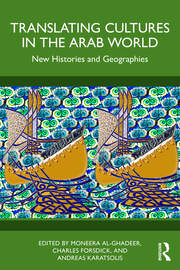
Translating Cultures in the Arab World New Histories and Geographies
Table of Contents
List of Contributors
Acknowledgement
Introduction: Rethinking Translating Cultures and the Arab World
Moneera Al-Ghadeer
Part I - Translating Cultures: Theoretical Frameworks and Foundational Concepts
1. The Importance of Translation for the Study of Cultures
Susan Bassnett
2. Translating Cultures: Origins and Future Directions
Charles Forsdick
3. Planetary Concept Work: Philology, Untranslatables, Language Justice
Emily Apter
4. Philosophy and Translation in the Arab World
Abdessalam Benabdelali
Part II- Translating Cultures in the Gulf Region: Case Studies and Emerging Paradigms
5. The Specter of Un-translatability and the First Saudi Opera, Zarqa al-Yamama
Moneera Al-Ghadeer
6. Arabophone Cultures of Translation: Patterns and Factors for their Emergence
Andreas Karatsolis and Mohammed Alsudairi
Part III- Historical Perspectives on Cultural and Translational Movements
7. Rethinking Translating Cultures: Cultural Translation and Appropriation in 16th-Century Islamic Spain
Ovidi Carbonell Cortes
8. Epistemic Translation: The Case of al-ʾintiqād by Ya’qub Ṣarrūf
Haifa Saud Alfaisal
9. Cultural Confluence: Loanwords as Vessels of Culinary and Cultural Exchange in Medieval Islamic Cookbooks: A Pilot Study
Dima Abdul-Jabbar
10. Cultural Confluence: Loanwords as Vessels of Culinary and Cultural Exchange in Cookbooks from the Islamic Golden Age: A Pilot Study
Dima Abdulmajeed Abduljabbar
Index
Biography
Moneera Al-Ghadeer holds the UNESCO Chair in Translating Cultures at the King Faisal Center for Research and Islamic Studies in Riyadh, Saudi Arabia. She was a visiting professor at Columbia University and Harvard University,
as well as a tenured professor at the University of Wisconsin-Madison.
Charles Forsdick is Drapers Professor of French at University of Cambridge and Lead Fellow for Languages at the British Academy.
Andreas Karatsolis is a senior lecturer and the permanent Director of Writing, Rhetoric, and Professional Communication (WRAP) at Massachusetts Institute of Technology (MIT), a program which supports the communication needs of all undergraduate MIT students.
"The volume reconceptualizes the history and movements of translation, beginning with the Middle East and the Arabic language, thus moving beyond a Western-centric and Anglo normative research perspective. Apart from translation studies, it will no doubt be useful for scholars working in discourse analysis, history, sociology, politics, and other related subjects."
-África Vidal Claramonte, Professor in Translation Studies, The University of Salamanca
"In its urgent call for re-entering the Arab-Islamic world epistemologically and methodologically, this book is a signal contribution to translation studies in the Arab world, poised to broaden the philosophical scope of its theorizing and to deepen its historical reach."
-Waïl S. Hassan, Professor and Head of the Department of Comparative & World Literature, University of Illinois Urbana-Champaign
"This fascinating series of theoretical interventions and richly informed case studies is a major re-mapping of the discipline of Translation Studies. Bringing together leading critics and theorists from Eurocentric and Arabic traditions, the volume underscores how foundational Arabic translation is to Western humanism and world culture generally."
Michael Syrotinski, Marshall Professor of French and Comparative Literature, Director, Centre for Comparative Literature and Translation, University of Glasgow
