





1st Edition
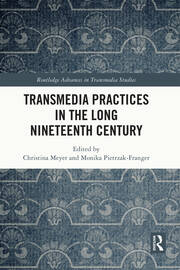
Transmedia Practices in the Long Nineteenth Century
Foreword by Matthew Freeman
1.Nineteenth-Century Transmedia Practices: An Introduction
Christina Meyer and Monika Pietrzak-Franger
Part I: Technology, Culture, Democracy
2. Literary Events and Real Policies: The Transmedia Cases of Walter Besant’s All Sorts and Conditions of Men (1882) and George Chesney’s The Battle of Dorking (1871)
Eckart Voigts
3. Telephonic Conversations: The Phone and Transmedia Competition in the Culture of the Progressive Era
Martin Lüthe
4. Transmedial Experience in Nineteenth-Century Live Theater Broadcasting
Heidi Liedke
5. Rose O’Neill’s Kewpies and Early Transmedia Practices
Ian Gordon
Part II: Crossroads of Fact and Fiction
6. Transmedia Practices Toward a Popular Cultural Sphere: Lippard, Thompson, and Nineteenth-Century Serialities
Lisanna Wiele
7. “She Lectured and Attended Lectures”: Transmedia Practices and Female Vocality in Late-Nineteenth-Century Cultures of Public Lecturing and Mass Print
Anne-Julia Zwierlein
8. Mobilizations: How Nellie Bly Traveled the World
Christina Meyer
Part III: Transmedia Sherlock
9. “To Just Steal the Name of a Character”: Arthur Conan Doyle, Sherlock Holmes and the Conditions of Transmedia Dispersion
Roberta Pearson
10. Creating Transmedia Fan Engagement in Victorian Periodicals: The Case of Sherlock Holmes
Ann McClellan
Biography
Christina Meyer is Associate Professor of American Studies, currently working at the TU Braunschweig, Germany. She is the author of Producing Mass Entertainment: The Serial Life of the Yellow Kid (2019).
Monika Pietrzak-Franger is Professor of British Cultural and Literary Studies at the University of Vienna, Austria. She has published on adaptation, transmediality, medicine and culture, (neo-)Victorianism, science, and globalization.
[An] outstanding project [that] allows us to see both the forest and the trees, the particular as a way into mapping a broader ecology of media practices in the long 19th century.
The editors [do] a spectacular job of […] describing why this period is important to our understanding of transmedia, why transmedia as a frame helps us to understand this period, why a practice-focus approach is valuable, and how the various contributors fit within this larger framework.
Henry Jenkins, Provost Professor of Communication, Journalism, Cinematic Arts and Education at the University of Southern California, USA
