




1st Edition
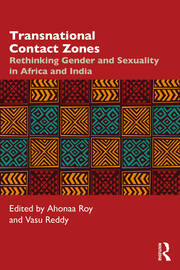
Transnational Contact Zones Rethinking Gender and Sexuality in Africa and India
Notes on the Contributors. Acknowledgements. Introduction. PART 1: Epistemic Decolonization and Intersubjective Inquiry 1. Mapping Gender onto Language: Identity Construction and its Symbolic Significance in the Trans-Koti-Hijra Community of India 2. The Struggle Against Tradition: An Inspection of Rafiki and Cobalt Blue, Africa 3. Emerging voices of queer ambassadors’ student group in promoting LGBTQ inclusive curriculum at a rural university in Eastern Cape province, South Africa 4. The influence of the Political Economy, 4th Industrial Revolution and Globalization on the North-South Binary 5. The Country, the City, and Postcolonial Queer and Trans Theory: Land, Migration, and Rural Imaginaries" PART 2: Rethinking Marginality: Sex, Embodiment, Discursive Participation 6. Borders vs. bodies: Experiences of transgender Migrants in South Africa 7. Respectably Gay: Race, Caste and Class Wars in India and South Africa 8. Towards Liberation: Queer South Asian Diasporic Conversations on Transnationalisms, Activisms, and Solidarities 9. ‘Libidinal Nationalism’: Perverse Sex, Corporeal Investment, Sign-Value in India and Brazil 10. Queering the Kunda - Sex, Food and the South African Indian 11. Postscript. Index.
Biography
Ahonaa Roy is an Associate Professor of Sociology, Social Anthropology and Policy Studies at the Indian Institute of Technology, Bombay, and a Research Associate in the Department of Sociology, University of Pretoria, South Africa. She has been part of several projects with the United Nations, USAID, and the Government of India. Her recent publications include, Gender, Sexuality Decolonization: South Asia in the World Perspective and Cosmopolitan Sexuality: Gender, Embodiments, Biopolitics in India.
Vasu Reddy is a Professor and Deputy Vice-Chancellor for Research and Internationalisation at the University of the Free State (UFS) and Research Associate in Sociology at the University of Pretoria. He is a member of the Academy of Sciences of South Africa (ASSAf) and a B1 NRF-rated scientist. A recent publication is Research and Activism: Ruth First and Activist Research (2025).
‘Combining interdisciplinary and deterritorialised methods, contributors to this volume open up new ways of thinking about sexuality and gender through multiple forms of hierarchies such as race, class and caste. The volume is a unique contribution to the re-fashioning of knowledge production through discussions that yoke the politics of intimacies with that of sociality.’
—Sanjay Srivastava, Distinguished Research Professor, Department of Anthropology and Sociology, SOAS University of London, UK
'Audacious in scope, grounded in urgent politics, Transnational Contact Zones is a powerful collaborative volume traversing the terrains of diaspora, rurality, migration, caste, and queerness, drawing methodological and analytical practices from both Africa and India to imagine new grammars of border thinking, gender and sexuality. What emerges is a textured conversation that foregrounds the lived realities of queer and trans communities - whether in the rural Eastern Cape, the diasporic kitchens of South African Indians, or the intimate solidarities of hijra life in India. The essays in this volume do not simply theorize the South, they dwell within its contradictions, respond to its urgencies, and imagine new transnational possibilities.
An indispensable decolonial resource for those committed to critical thinking across and beyond borders.'
—Zethu Matebeni, Independent Scholar, Nelson Mandela University'What theories of gender and sexuality are made possible through research centered in the ideas of people in the Global South? Moving across continents, Transnational Contact Zones is a vital contribution to thinking about the geopolitics of gender and sexuality between the intimately linked worlds of South Asia and the African continent. Moving through and beyond borders, this powerful collection offers insights into novel transnational research on the visions of women, queer, and trans studies. The volume explores wide-ranging issues, including rural sexualities, gender and food, land contestations, the politics of embodiment, human rights, and the gendered dimensions of international relations in India and Africa.'
—Durba Mitra, author of Indian Sex Life (2020) and The Future That Was (2026), Richard B. Wolf Associate Professor of Women, Gender, and Sexuality, Harvard University
