




1st Edition
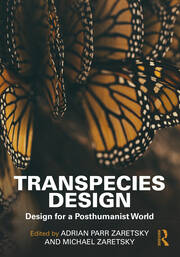
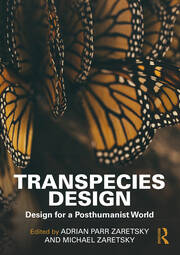
Transpecies Design Design for a Posthumanist World
SECTION I: Co-Habitation
1. How Does Ecological Science Support Transpecies Design?
Steward Pickett
2. Interspecies, Multispecies, or Transpecies Design? What’s the Difference?
Adrian Parr Zaretsky
3. Transpecies Design and Biomimicry
Henry Dicks
4. Design Against Extinction: Multispecies Methods and Engineered Living Materials
Mitchell Joachim
5. Garden City to City in Nature: A Case for the Cohabitation of Tidal Ecologies along Singapore’s Urban Waterfront
Gabriel Tenaya Kaprielian
6. Floating-With: Buoyant Ecologies of Collaboration and Solidarity
Adam Marcus, Margaret Ikeda, and Evan Jones
7. Unbecoming Human: Patricia Picinini’s Bioart and Postanthropocentric Posthumanism
Kate Mondloch
8. Salt Formations
Rosalea Monacella
SECTION II: Co-Creation
9. Origin and Evolution of Biodiversity: A Story of Life on Earth
Christian Sardet
10. Adrian Parr Zaretsky in Conversation With Janet Laurence
Adrian Parr Zaretsky and Janet Laurence
11. Birdsong and the Transpecies Aesthetic
David Rothenberg
12. Entangled Intelligences: Transpecies Dialogues of Art
Jiabao Li
13. Designing with Non-Humans: Ralph Ghoche in Conversation With Joyce Hwang
Ralph Ghoche and Joyce Hwang
14. The Problem Is the Burning House
Catherine Page Harris
15. Everything With Wings
Sarah Walko and Gabriel Willow
16. Adrian Parr Zaretsky in Conversation With Carla Bengston
Adrian Parr Zaretsky and Carla Bengston
17. Piñon Passage
Nina Elder
Biography
Adrian Parr Zaretsky is the Dean of the College of Design at the University of Oregon, UNESCO Chair of Water and Human Settlements, and a Senior Fellow of the Design Futures Council. She is a philosopher, storyteller, and creative practitioner. She curated the Transpecies Design exhibition for the European Cultural Center’s Space, Time, Existence 2023 Venice Architecture Biennale and the Watershed Urbanism exhibition for the 2021 ECC Venice Architecture Biennale. Her documentaries and art films have received numerous awards at independent film festivals around the world. She has published extensively on environmental culture and politics and her most recent book publication Earthlings (Columbia University Press 2022) earned a silver medal at the 2023 Nautilus Books Awards (environment category). Other publications include the trilogy: Birth of a New Earth (Columbia University Press 2017), The Wrath of Capital (Columbia University Press 2012), and Hijacking Sustainability (MIT Press 2009). She is the editor, with Santiago Zabala, of the Outspoken series published with McGill University Press.
Michael Zaretsky, AIA, is an Associate Professor and Head of the Department of Architecture in the College of Design at the University of Oregon. Zaretsky is a licensed architect with extensive experience in local and international design/build projects. His research is focused around culturally and environmentally responsive public interest design projects and community engagement with underserved communities locally and internationally. His published work includes Precedents in Zero-Energy Design: Architecture and Passive Design in the 2007 Solar Decathlon (Routledge Press 2009) and New Directions in Sustainable Design, with Dr. Adrian Parr Zaretsky (Routledge Press 2010). Zaretsky has articles published in several architectural journals and has presented at conferences around the world on Sustainability, Humanitarian Design, Public Interest Design, Design/Build and Community Engagement. From 2008–18, he was the Director of Design for the Roche Health Center in rural Tanzania, a Village Life Outreach Project. Roche Health Center is the first-ever permanent healthcare facility in this region. The Roche Health Center opened on April 1, 2011, and provides health care to as many as 20,000 villagers. From 2011–18, he was the Director of MetroLAB Design/Build, an academic community design/build program at the University of Cincinnati. His work is included in the 2018 book The Public Interest Design Education Guidebook, edited by Bell and Abendroth.
