





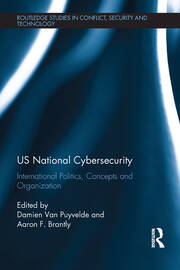
1st Edition
US National Cybersecurity International Politics, Concepts and Organization
1. Introduction, Damien Van Puyvelde and Aaron F. Brantly
PART I: The International Politics of Cybersecurity
2. Cybersecurity and Cross Domain Deterrence, Jon Lindsay and Erik Gartzke
3. Crossing the Rubicon: Identifying and Responding to an Armed Cyberattack, Nerea M. Cal
4. The Outlook for Constraining International Norms for Offensive Cyber Operations, Brian Mazanec
5. Developing an International Cyberspace Security Governance Framework: Comparisons to Outer Space, Tim Ridout
PART II: Conceptualizing Cybersecurity
6. Traditional Military Thinking in Cyberspace: The Need for Adaptation, Jan Kallberg
7. Epidemiological Approaches to National Cybersecurity, Aaron F. Brantly
8. The Defender’s Innovator’s Challenge: Can the US Army Learn to Out-Hack Those Who Attack Us in Cyberspace?, Ernest Y. Wong, Katherine R. Hutton And Ryan F. Gagnon
9. Evolving Cyber Intelligence, Stephen Gary and Randy Borum
10. Changing the Game: Cyberspace and Big Data Driven National Security Intelligence, Aaron F. Brantly
PART III: Organizing Cybersecurity
11. Cybersecurity in the United States and the United Kingdom: The Need for Trust and Cooperation, Kris Stoddart
12. From Information to Cybersecurity: Bridging the Public-Private Divide, Damien Van Puyvelde
13. Training Cyber Intelligence Coalitions, Scott Bethel and John Whisenhunt
14. Conclusion, Aaron F. Brantly AND Damien Van Puyvelde
Biography
Damien Van Puyvelde is Assistant Professor of Security Studies at The National Security Studies Institute, The University of Texas at El Paso.
Aaron F. Brantly is Assistant Professor in the Department of Social Sciences and the Army Cyber Institute, West Point, USA. He is author of The Decision to Attack: Military and Intelligence Cyber Decision-Making (2016).
