




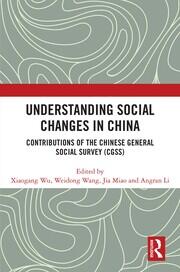
1st Edition
Understanding Social Changes in China Contributions of the Chinese General Social Survey (CGSS)
Introduction: Understanding Social Change in Contemporary China through the Chinese General Social Survey
Xiaogang Wu, Weidong Wang, Jia Miao and Angran Li
1. Changes in women’s labor force participation in urban China between 1990 and 2019:
an age-period-cohort analysis
Yuxiao Wu, Zixu Han and Sijia Du
2. Changing pathways in young people’s school-to-work transition: evidence from the 2003-2021 Chinese General Social Surveys
Jin Jiang, Chunni Zhang and Xiuming Pan
3. Living with parents or attaining residential independence? A comparative study of young adults’ living arrangements in China and South Korea
Soo-Yeon Yoon and Bin Lian
4. Hukou Intermarriage in China: Patterns and Trends
Lake Lui
5. Does Marrying Well Count More Than Career? Personal Achievement, Marriage, and Happiness of Married Women in Urban China
Meng Chen
6. Individual’s gender ideology and happiness in China
Yan Zhang and Hui Liu
7. Gender differences in objective and subjective social reproduction in China: do educational attainment and social capital matter?
Songyun Shi, Zurong Liang and Huiquan Zhou
8. Two-Dimensional Stratification of Subjective Social Status in China from 2006 to 2021: A New Perspective on Objective-Subjective Status Alignment
Boyan Zheng and Lai Wei
9. The Effects of Media Use and Traditional Gender Role Beliefs on Tolerance of Homosexuality in China
Kang Hu and Xinling Li
10. Rethinking the tunnel effect: income comparison and the dynamics of happiness in a changing economic landscape (2005-2018)
Hania Fei Wu
Biography
Xiaogang Wu is the Yufeng Global Professor of Social Science and Professor of Sociology at NYU Shanghai and New York University, USA, and the Founding Director of the Center for Applied Social and Economic Research (CASER) at NYU Shanghai, China. His research and teaching interests include Chinese society, social inequality and stratification, survey and quantitative methods, and urban sociology. He has served as Chief Editor of Chinese Sociological Review since 2011 and is a Co-Principal Investigator (Co-PI) of the Chinese General Social Survey (CGSS).
Weidong Wang is Professor of Practice in the Faculty of Social Sciences and Executive Director of the Social Science Research Centre at the University of Hong Kong, China. From 2012 to 2024, he served as Deputy Director of the National Survey Research Center at Renmin University of China, and a Co-Principal Investigator (Co-PI) of the Chinese General Social Survey (CGSS), and the Principal Investigator (PI) of the China Education Panel Survey (CEPS) and the Chinese Religious Life Survey (CRLS).
Jia Miao is an Assistant Professor of Sociology at NYU Shanghai, China. Her research examines how urban neighborhoods shape social cohesion, health inequality, productive aging, and subjective well-being in the Asian context. She is also interested in the social consequences of homeownership in large Chinese cities. Her work has appeared in Social Science & Medicine, Social Forces, and other leading journals.
Angran Li is an Assistant Professor of Sociology at NYU Shanghai, China, and an affiliated member of the Center for Applied Social and Economic Research (CASER). His research focuses on social stratification and inequality, the sociology of education, family, higher education, urban sociology, and quantitative methods. His work has been published in Social Forces, Sociology of Education, Social Science Research, Chinese Sociological Review, and other peer-reviewed journals.
