





1st Edition
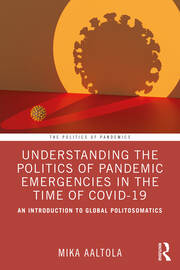
Understanding the Politics of Pandemic Emergencies in the time of COVID-19 An Introduction to Global Politosomatics
1. Introduction
2. Pandemic Dramas: Containment Efforts and ’Nearest is Dearest’ Compassions
3. Understanding Grand Vortexes: The Classical Model for Politics and Plagues
4. Global Mobility-Based Order: The Disruptions of SARS and COVID-19
5. The Geopolitics of SARS and COVID-19
6. Covid-19 as a Catalyzer of Growing Anxiety, Political Distancing and Global Decoupling
7. Dynamics of an Epidemic of International and of National Origin: Cases of Haiti Cholera and the Mad Cow Disease
8. Beyond Pandemic Security
Biography
Mika Aaltola is Director of the Finnish Institute of International Affairs, Finland; Full Professor of International Relations and European Studies at Tallinn University, Estonia; and docent of International Relations at the University of Tampere, Finland.
"Mika Aaltola has made a highly important contribution to the understanding of how pandemics impact geopolitics. He shows how the COVID-19 pandemic has done so in ways similar to previous — and probably future — pandemics."
Mark N. Katz, Professor, George Mason University Schar School of Policy and Government, USA; Chairperson, Scientific Advisory Council, Finnish Institute of International Affairs.
"Thinking back to 2012 about the impact of major pandemics on global politics was a visionary act. Revisited in the light of COVID-19, this book vindicates all the research hypotheses put forward by the author ten years ago. Concise and brilliant!"
Christian Lequesne, Sciences Po, Paris, France.
