




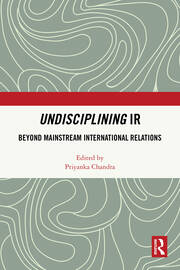
1st Edition
Undisciplining IR Beyond Mainstream International Relations
1. On ‘Undisciplining’
Priyanka Chandra
UNIT I - Reorienting the ‘Self’: Critical Theoretical Frameworks and Methodologies
2. From Ideological Appropriations in Space to Spatial Appropriation of Ideas
Matthew Varghese
3. Shi’i Rationalism through the Institution of Marji’at
4. Islamic Cosmopolitanism and Critique of Orientalist Discourses on Islam
Prem Mishra
UNIT II - Asserting the ‘Self’: Structures and Strategies in Praxis
5. Arab Refugee Women: An Intersectional Analysis of Refugee Experiences
Azeemah Saleem
6. Family Law Reform and Inheritance Discourses in the Arab World
Shabista Naz
7. Artificial Intelligence and The Reproduction of Colonial Power Structures in West Asian Conflicts
Pooja Kotwal
8. Contemporary Politics and Cosmopolitanism in Iran: Lessons for IR Studies
Umesh Kumar
UNIT III - Unconventional Archives
9. Olive Trees, Resistance, and Colonial Contestations in Palestine: A Political and Ecological Analysis
Aysha Sana
10. Symptoms and the Symptomatologists: A Study of Settler Psychopathology
Shakeel Anjum and Anissa Haddadi
11. Memory, Homeland and Text: Re-imagining Liberation through Palestinian Struggle
Ashutosh Singh
Biography
Priyanka Chandra is Associate Professor of Politics and International Relations at the Jindal School of International Affairs (JSIA), O.P. Jindal Global University (JGU), Sonepat, India. She is co-director of the research series Critical Interventions in Arts and Cultural Studies, a transdisciplinary research programme that focuses on intersections of art, culture, and politics in the Global South. She is Senior Research Fellow at IDEAS, Office of Interdisciplinary Research, JGU. She obtained her PhD from Jawaharlal Nehru University (JNU), New Delhi, India. She is the author of Postcoloniality and Statehood: The Case of Egypt (Routledge, 2026).
‘This festschrift celebrates A.K. Ramakrishnan’s enduring challenge to hegemonic knowledge in IR. Through critical engagements with postcolonial theory, Islamic cosmopolitanism, gender, artificial intelligence, and the Palestinian question, the contributors demonstrate how IR must be “undisciplined” to confront its own colonial inheritances. The volume offers scholars of South and West Asia a rigorous and politically conscious framework for reimagining the discipline.’
- JAMES ONLEY, Ahmed Seddiqi Chair in Gulf and Middle Eastern Studies, American University of Sharjah, UAE
‘Subscribing to A.K.Ramakrshnan’s line of thinking, this volume stands for a refocusing of IR theory away from the traditional domains of nation-state, power, diplomacy, and security. Repositioning the discipline which in its popular imagination is profoundly grounded in Eurocentric, elitist and statist experiences, this work draws attention to the differently situated experiences of people and movements of global south, such as women, minorities, refugees, whose voices were previously unheard of or completely excluded from the mainstream IR. Touching a relatively unchartered terrain, this book contributes significantly to the reimagining of conventional IR.’
- M.H.ILIAS, Professor and former Dean, Faculty of Social Sciences, Mahatma Gandhi University, India
‘Deeply impressed by the excellence of the contents of the festschrift to honour the unique contributions made by Prof. Ramakrishnan to his discipline. His philosophical approach to the discipline is humanity- centred and not state-centred. For him the state is only an instrument devised by humans. As a professional diplomat, I recall with joy and gratitude my conversations with him. His work is a study in holistic reasoning and rare clarity.’
- Ambassador K.P. FABIAN, Professor, Symbiosis University, India
