




1st Edition
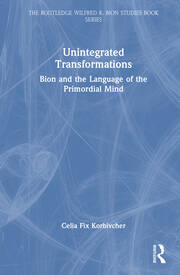
Unintegrated Transformations Bion and the Language of the Primordial Mind
INTRODUCTION 1. A DISCUSSION CONCERNING BION AND THE CLINIC: ABOUT TECHNIQUE AND METHOD 2. BION AND THE THEORY OF TRANSFORMATIONS. THE ANALYST'S MIND: PERSONALITY AND THEORIES 3. CONSIDERATIONS ON GRADATIONS OF AWARENESS OF THE BODILY SEPARATION BETWEEN SELF AND OBJECT MAKING CONTACT WITH PSYCHOTIC AND AUTISTIC PHENOMENA 5. BION AND UNINTEGRATED PHENOMENA: "FALLING AND DISSOLVING" 6. BION AND EMOTION: EMOTION, NON-EMOTION, AND THE ANALYST’S LANGUAGE 7. THE PRIMORDIAL MIND AND THE LANGUAGE OF THE ANALYST: A LANGUAGE OF EMOTION 8. THE PRIMORDIAL MIND AND THE BODY: THE NO-BODY AND BECOMING A BODY 9. THE CONCRETE PATIENT: A CHALLENGE FOR THE ANALYST'S MIND
Biography
Celia Fix Korbivcher is a teaching analyst, supervisor and child analyst in private practice based in São Paulo, Brazil. She is a member of the Brazilian Society of Psychoanalysis and is the author of Autistic Transformations: Bion's Theory and Autistic Phenomena (2013).
‘In Unintegrated Transformations: Bion and the Language of Primordial Mind, Dr. Korbivcher tackles one of the most demanding challenges in clinical practice: how to make authentic contact with the primordial, unintegrated mental states we increasingly encounter in our patients — outwardly neurotic, yet dominated by deep psychotic nuclei that obstruct genuine mental development.
Building on her earlier explorations of autistic transformations, the author now turns her attention to the analyst's own mind as the primary instrument of the therapeutic encounter. Through lucid writing and remarkably sensitive clinical examples — drawn from work with both children and adults — she guides the reader into the inner workings of analytic perception: its trained intuition, its constant discipline of self-observation, and its hard-won capacity to tolerate not-knowing without retreating into premature certainty.
True to Bion's teaching, which prized curiosity over ready-made answers, Korbivcher demonstrates how genuine therapeutic transformation arises from the willingness to dwell in uncertainty, remaining open to stray feelings and nascent thoughts that have not yet become ideas in any conventional sense. She reminds us that the analyst must continuously discern what belongs to their own inner world and what is being projected by the patient's most archaic states.
The result is a strikingly original contribution — clinically rich, theoretically rigorous, and deeply humane — that asks the most fundamental questions about what psychoanalysis truly is, and what it demands of those who practice it. This book deserves a place on every analyst's desk.’
Giuseppe Civitarese, author of The Limits of Interpretation: Essaus on Bion and Field Theory, Routledge, 2025
