





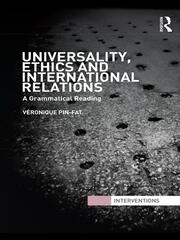
1st Edition
Universality, Ethics and International Relations A Grammatical Reading
1. Reading Grammatically:Reading, representation and the limits of language 2. Universality as Conjunctive Solution: Ethics 'and' International Relations 3. Divine Universality: Morgenthau, alchemy and the national-interest 4. Ideal Universality: Beitz, reason and the ghost of Houdini 5. Binary Universality: Walzer, thinning the thick and fattening up the thin 6. In Defence of Universality: (Im)possible univeralism
Biography
Véronique Pin-Fat is senior lecturer in International Relations in the Centre for International Politics at the University of Manchester. She is co-editor of Sovereign Lives: Power in Global Politics (2004) with Jenny Edkins and Michael J. Shapiro.
'A sophisticated and refreshing argument against the metaphysical seductions of universalism in IR theory. Pin-Fat's Wittgensteinian 'grammatical reading' takes theories of international ethics back to the rough ground in ways that challenge realist, cosmopolitan and communitarian approaches.' - Kimberly Hutchings, London School of Economics, UK
'Central to critical discourses in International Relations are questions related to what constitutes the ‘universal’, how it is used in political thought, and the ways in which it relates to operations of power in global politics. Veronique Pin-Fat’s ‘grammatical’ reading is one of the most original interventions on the relationship between ethics, universality, and international politics, bringing not only Wittgenstein, but her own voice to our deliberations. This is one of the most challenging contributions to international relations theory in general and to critical thought in particular.' - Vivienne Jabri, Kings College London, UK
