





1st Edition
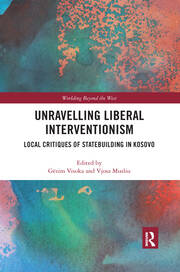
Unravelling Liberal Interventionism Local Critiques of Statebuilding in Kosovo
1. Introduction: Local Critiques of Intervention and Statebuilding 2. International Statebuilding and Local Resistance in Kosovo 3. From Kosovo with Hospitality: Rethinking Hospitality Beyond Westphalia 4. The Hyperreality of Enlargement: A Baudrillardian Critique of the European Union in Kosovo 5. Local Inclusion or Exclusion? Security Sector Development in Kosovo 6. Making the Law, Ruling the Law: International Statebuilding and the Rule of Law in Kosovo 7. The Local Voices and Agency in Statebuilding: A Life Story Perspective 8. Voices of the Serb Minority in the Assembly of Kosovo 9. Inside-Out and Outside-In on Dealing with the Past in Kosovo: Actors, Voices, and Practices 10. The Subaltern of the Local: The Roma, Ashkali and Egyptian Women and Statebuilding in Kosovo 11. The Politics of Citizenship, Social Policy, and Statebuilding in Kosovo 12. Conclusion: After Local Critiques
Biography
Gëzim Visoka is Assistant Professor of Peace and Conflict Studies at Dublin City University, Ireland.
Vjosa Musliu is Assistant Professor at the Department of Political Science, Free University of Brussels (VUB), Belgium.
"A superb collection on Kosovo’s statebuilding process written by a distinguished group of local scholars. This book is a staunch contribution to understanding the challenges that underpin contemporary efforts for building peace and creating states after violent conflict. A must-read for scholars and practitioners of international relations alike." - Atifete Jahjaga, President of the Republic of Kosovo (2011-2016)
"A rare and valuable study by a group of Kosovar scholars that argues that local actors are not passive targets but critical agents of legitimation and success of international peacebuilding efforts. A timely contribution to the literature on peacebuilding that also strengthens the emerging field of Non-Western and Global IR." - Prof. Amitav Acharya, American University, USA
"Taking its prompt from postcolonial challenges critiques of Eurocentrism in International Relations theory, this book insightfully reassesses the local dimensions and meanings of intervention. It does so, however, by addressing Europe’s intimate other – Kosovo. The editors have curated a wide-ranging and edifying set of contributions that turn the postcolonial critique towards Europe’s own borderlands. As such, this book marks a crucial contribution to - and innovation in – debates surrounding intervention and statebuilding." - Prof. Robbie Shilliam, John Hopkins University, USA
