




1st Edition
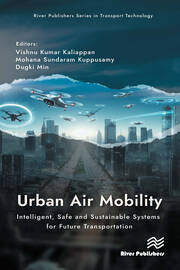
Urban Air Mobility Intelligent, Safe and Sustainable Systems for Future Transportation
1. Toward Future Transportation: History, Adoption, Research, and Development, Challenges in Urban Aerial Mobility
R. Sivaramakrishnan, Dhivya Rathinasamy, Agus Budiyono, and Min Dugki
2. Modelling and Analysis of urban transportation systems
V. Sakthivel, Sourav Patel Kurmi, P. Prakash, and Jae-Woo Lee
3. System Dynamics Model of Urban Transportation System
V. Sakthivel, Sourav Patel Kurmi, P. Prakash, Sam Goundar, and Jueying Li
4. Deep Learning Methods for High-Level Control Using Object Tracking
P. Kanmani, N. Yuvaraj, S. Karthic, Sri Preethaa K. R., and Min Dugki
5. Deep Learning Models for Urban Aerial Mobility: A Review
K. Kathiresan, N. Yuvaraj, Sri Preethaa K. R., and Sangwoo Jeon
6. Reinforcement Learning for Automated Electric Vertical Takeoff and Landing Decision Making of Drone Taxi
M. Shyamala Devi, R. Aruna, N. Yuvaraj, and Sri Preethaa K. R.
7. Urban Aerial Mobility Concepts, Modelling and Challenges: A Review
Premkumar Duraisamy, Yuvaraj Natarajan, and Sri Preethaa K. R.
8. Reinforcement Learning Approaches for Urban Air Mobility/Navigation and Traffic Control Systems
Sango Woo Jeon, J. Dharani, Min Dugki, and Vishnu Kumar Kaliappan
9. Challenges in charging of Batteries for Urban Air Mobility
K. Mohana Sundaram and B. Kavya Santhoshi
10. Safety and Security challenges in implementing Urban Air Mobility
Dhivya Rathinasamy, R. Sivaramakrishnan, R. Pavithra, and Vishnu Kumar Kaliappan
Biography
Vishnu Kumar Kaliappan is working as Professor in Computer Science and Engineering Department at KPR Institute of Engineering and Technology & Konkuk University Seoul, South Korea and has 15.8 years of Teaching and Research Experience. He received his Ph.D in Computer and Information Communication Engineering from Konkuk University, Seoul, South Korea during 2012 and received M.Tech in Communication Engineering from VIT University, Vellore, India. He is an Editorial Manager at ISIUS (International Society of intelligent Unmanned System), Korea. He worked the project under KARI (Korean Aerospace Research Institute), Degu, South Korea and at CABS (Centre for Air Born System), DRDO, Bangalore, India. He received one of the Korean prestigious Scholarship IITA (International Information Technology Admission) from Ministry of Information Technology, Seoul, South Korea in the 2007-2012. He has published more than 70 peer reviewed Journals, conference and book chapters. The focus of his research is on Reinforcement Learning, bio mimetic algorithms, Cyber Physical System, Hardware in the Loop Simulation (HILS) and Control algorithms for unmanned aerial vehicles. He has been acted as reviewer and editorial member for more 70 international conference and journals.
Mohana Sundaram Kuppusamy received B.E. degree in Electrical and Electronics Engineering from University of Madras in 2000, M.Tech degree in High Voltage Engineering from SASTRA University in 2002 and Ph.D. degree from Anna University, India in 2014. His research interests include Intelligent controllers, Power systems, Embedded system and Power electronics. He has completed funded project of worth Rs.30 .79 lakhs sponsored by DST, Government of India. Currently he is working as a Professor in EEE department at KPR Institute of Engineering and Technology, India. He has produced 04 Ph.D candidates under his supervision in Anna University, Chennai. He has published three books and serving as reviewer for IEEE, Springer and Elsevier journals. He is an active member of IE, ISTE and IAENG. He has published around 47 papers in International journals.
Dugki Min received the B.S. degree in industrial engineering from Korea University, Seoul, South Korea, in 1986, and the M.S. and Ph.D. degrees in computer science from Michigan State University, East Lansing, MI, USA, 1991 and 1995, respectively. He is a Professor with the Department of Computer Science and Engineering, College of Engineering, Konkuk University, Seoul, where he is the Head of Distributed Multimedia Systems Laboratory. His current research interests include multiagent systems, deep learning and deep reinforcement learning, intelligent Internet of Things, cyber–physical systems, digital twin systems simulation, intelligent big data analysis, intelligent fog computing, proactive provisioning for cloud computing, distributed and parallel computing, software architecture design, and performance, and dependability analysis.
