





1st Edition
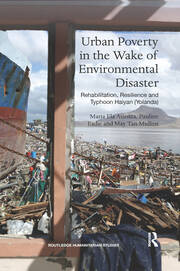
Urban Poverty in the Wake of Environmental Disaster Rehabilitation, Resilience and Typhoon Haiyan (Yolanda)
1. Introduction 2. Poverty, Vulnerability and Risk 3. The Philippines: poverty, urbanization and disasters 4. The Roles of Foreign and International Agencies in Disaster Risk Reduction and Management 5. The Role of National and Local Governments in Disaster Risk Reduction and Response 6. An act of humanity or mercenary? Global and local politics of aid in the context of Typhoon Yolanda 7. Rebuilding Communities Through Social Capital, Trust and Networks 8. Conclusion
Biography
Maria Ela Atienza, Department of Political Science, University of the Philippines Diliman, the Philippines.
Pauline Eadie, School of Politics and International Relations, University of Nottingham, Nottingham, UK.
May Tan-Mullins, School of International Studies, University of Nottingham, Ningbo, China.
"This book invites reflection on the politics and possibilities of governance in perilous times. It offers empirically-grounded insights about the structural causes of vulnerability and challenges readers to consider innovative solutions to disaster response, rebuilding and rehabilitation." — Nicole Curato, Senior Research Fellow, Centre for Deliberative Democracy and Global Governance, University of Canberra, Australia
"With their cutting-edge research on post-disaster relief and recovery, Pauline Eadie and her team deliver valuable lessons-learned from the aftermath of Typhoon Yolanda in the Philippines. If you want to know how post disaster poverty-relief strategies succeed or fail and why, this is the book!" — Deirdre McKay, Keele University, UK and author of Global Filipinos and Archipelago of Care
"Finally, a definitive and comprehensive assessment of Typhoon Yolanda has been produced. This book will be useful for everyone who aims to understand what happened, what has been done, and why certain disaster relief and rehabilitation strategies worked while others did not, before, during and after Typhoon Yolanda. This book also offers valuable guidance on how similar work should be undertaken in the future. The book is encompassing in its treatment of post-Yolanda recovery and assessment of the predicaments that arose during post-disaster reconstruction. While it will not provide solace to those who are dismayed at the outcomes, it will at least provide clarity on some of the nagging questions that remain about why rehabilitation efforts stalled after the initial humanitarian and emergency recovery phase ended. The findings and implications presented in this book are representative of the five year time frame since Typhoon Yolanda. However the post-Yolanda rehabilitation effort is an ongoing process and many of the issues raised are yet to be resolved. This will continue to be the case,
