





1st Edition
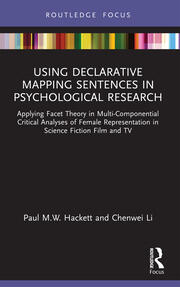
Using Declarative Mapping Sentences in Psychological Research Applying Facet Theory in Multi-Componential Critical Analyses of Female Representation in Science Fiction Film and TV
1: Introduction
2: Star Trek: The Original Series – "The Man Trap": The Woman Who Craves Men and the Woman Who Eats Men
3: Blade Runner: Do Sexualised Androids Dream of Gender Equality?
4: Ex Machina: Female Machines Versus Their Male Dictators
5: Star Trek: Discovery – "The Vulcan Hello": A Utopian Universe
6: Conclusion: Synthesis of Findings
Biography
Paul M. W. Hackett is Professor of Ethnography and Research Methods at Emerson College, USA, Visiting Professor in the Department of Philosophy, Nnamdi Azikiwe University, Awka, Nigeria, Visiting Professor of Health Research Methods at Univertsity of Suffolk, UK, and Visiting Scholar at Royal Anthropological Institute, UK. He is the author of Facet Theory and the Mapping Sentence, second edition (2021),and Declarative Mapping Sentence in Qualitative Research (2021), and a co-author of An Introduction to Using Mapping Sentences (2021).
Chenwei Li completed her master's degree in Strategic Communication for Marketing in the School of Communication, Emerson College, USA, and her bachelor's degree in Film and Media Studies in the School of Humanity, University of California Irvine, USA.
