




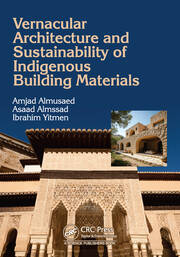
1st Edition
Vernacular Architecture and Sustainability of Indigenous Building Materials
Preface
Book Introduction
PART I: CONCEPTUAL FOUNDATIONS FOR VERNACULAR SUSTAINABILITY
1. Reconceptualizing Sustainability through Vernacular Architectural Intelligence
2. Theoretical and Interdisciplinary Frameworks for Vernacular Analysis
PART II: REGIONAL PRACTICES OF VERNACULAR ARCHITECTURE
Section 1: South and East Asia: Bioclimatic Adaptation and Spiritual Ecology in Dense Settlements
3. India’s Indigenous Earthen Architecture: Harmonizing Vernacular Practice with Climatic Diversity
4. Vernacular Harmony in Chinese Architecture: Courtyards, Earth, and Spatial Orientation
5. Japan and Korea (Hanok) – Seismic Vernaculars: Timber Joinery, Flexibility, and Nature-Space Relationships Integration
Section 2: Middle East and Central Asia: Material Pragmatism and Climatic Ingenuity in Arid Environments
6. Yemen – Vertical Earth: Shibam and the Typology of the Mudbrick High-Rise
7. Iraq – Courtyard Architecture and Thermal Logic in the Mesopotamian Context
8. Turkey, Iran, and Central Asia – Domes, Windcatchers, and Subterranean Settlements
Section 3: Africa, the Mediterranean, and the Americas: Earthen Construction, Settlement Morphology, and Social Ecology
9. North Africa – Oasis Urbanism and Fortified Earthen Settlements
10. Mexico – Indigenous Earth Building, Cosmology, and Climatic Design
Section 4: Europe: Material Rationality and Climatic Adaptation in Temperate and Cold Zones
11. The Balkans, Romania, and Cyprus – Transitional Vernaculars of Stone, Wood, and Topography
12. England and Scandinavia – Thermal Efficiency, Timber Logic, and Climatic Innovation
13. Northern Europe – Compactness, Brick Craft, and Climatic Rationalism
PART III: REGIONAL PRACTICES OF VERNACULAR ARCHITECTURE
14. Toward Vernacular Futures: Design Practice, Educational Reform, and Global Policy Integration
Biography
Amjad Almusaed is a scholar specializing in the relationship between architecture and environmental design. He earned a Ph.D. from Ion Mincu University in Bucharest, Romania. In 2004, he undertook postdoctoral research at the School of Architecture in Aarhus, Denmark, focusing on sustainable and bioclimatic housing. This study highlighted his strong dedication to incorporating sustainability ideas into building design and urban planning. He has conducted thorough study, research, and technical assessments in these crucial areas throughout his academic career.
Professor Almusaed has made substantial contributions to the scholarly community as an editor and reviewer. He has taken on editorial duties for several prestigious publications. He has curated and edited more than 15 volumes on various topics such as architecture, urbanism, smart cities, and energy-efficient structures. He has authored five monographs and textbooks, reflecting his research focus on environmental sustainability in design. He has demonstrated his dedication to academic excellence by participating in peer reviewing over 200 academic articles for renowned publishers. His commitment to upholding intellectual honesty and advancing research in the field of architecture is evident in this area of his professional life. Professor Almusaed is involved in several architectural organizations globally in addition to his accomplishments as an editor and author. His commitment to fostering worldwide dialogues on sustainable and ecologically conscious design techniques is evident in this collaboration. He has published over 185 academic works, such as articles, studies, books, and book chapters in many languages, making significant contributions to the academic discussion on architecture and sustainability. His bibliography demonstrates a career dedicated to spreading and progressing knowledge in his area, establishing him as a key player in the discussion of incorporating sustainable and bioclimatic concepts in architecture and urban planning. Throughout his academic path, he has consistently sought information and shown a strong commitment to improving the sustainability of our built surroundings.
Asaad Almssad, a distinguished civil engineering scholar with over 30 years of experience, has contributed significantly to academia, industry, and research. Holding position at Karlstad University in Sweden, as well as international entities, his work focuses on building materials, structural engineering, sustainable construction practices, and energy efficiency in building systems. Professor Almssad's scholarly achievements include over sixty research papers and several authored books, marking him as a prominent figure in his field. He is notably recognized for his expertise in sustainable construction and structural engineering, offering consultancy on incorporating green practices into construction projects. His textbook, "Concrete and Construction," widely used in Swedish universities, bridges the gap between theoretical knowledge and practical application in concrete technology and construction practices. As a docent at Karlstad University, Professor Almssad continues to influence the future of sustainable construction and structural engineering through his research and teaching, mentoring the next generation of engineers and researchers. His commitment to advancing sustainable construction practices highlights his role as a key contributor to the field of civil engineering.
Ibrahim Yitmen has a PhD in Architecture from Istanbul Technical University, Turkey. He has been a Professor in Management of Construction Production at Jönköping University, Sweden since 2018. His research focus is mainly on Innovation in Construction involving socio-technical issues regarding digital transformation in AEC industry, and his recent special interest is on Digital Twin-based Smart Built Environment, Construction 5.0 and Sustainable Resilient Habitats, Augmented Reality/Mixed Reality for Cognitive Buildings, Integration of Digital Twins and Deep Learning for Smart Planning and Construction, and Blockchain Technology in Construction Supply Chains.
Professor Yitmen has published more than 140 research papers in refereed international journals and in peer reviewed conference proceedings. He has 2 recent edited volumes to his credit. He was one of the guest editors of the MDPI Journal Applied Sciences for the Special Issue "Cognitive Buildings". Professor Yitmen serves on the scientific committees of the international conferences held by the International Council for Research and Innovation in Building and Construction, American Society of Civil Engineers, and European Council on Computing in Construction. Dr Yitmen is reviewer of several important peer-reviewed journals. He has been an active member of American Society for Engineering Management, USA since 2010.
