




1st Edition
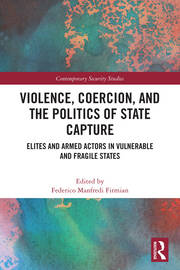
Violence, Coercion, and the Politics of State Capture Elites and Armed Actors in Vulnerable and Fragile States
Introduction: Violence, Coercion, and the Politics of State Capture—Elites and Armed Actors in Vulnerable and Fragile States
Federico Manfredi Firmian
1 How Iran-Aligned Militias Seized Iraq: Irregular Warfare, Lawfare, and Regime Change
Crispin Smith and Michael Knights
2 State Capture in Madagascar: Power, Profits, and Resistance
Ketakandriana Rafitoson and Thomas Shipley
3 Russia’s State Capture Strategy in Africa, from Wagner to the Africa Corps
Federico Manfredi Firmian
4 Hezbollah’s State Capture in Lebanon
Lina Khatib
5 Beyond State Capture: The Case of the Rapid Support Forces (RSF) in Sudan
Majak D’Agoôt
6 Capturing Calabria? ‘Ndrangheta, Corruption, and Maladministration in Local Public Institutions in Southern Italy
Anna Sergi and Alberto Vannucci
7 From Conventional Insurgency to Binational Criminal Syndicate? ELN’s State Capture in the Colombia–Venezuela Borderlands
Jorge Mantilla and Andreas E. Feldmann
8 Capturing the State, Undermining Democracy: Organized Crime in Post-2000 Mexico
Dolores Trevizo
Conclusion: Patterns, Pathways, and Perils of State Capture
Anthony Wanis-St. John
Biography
Federico Manfredi Firmian is Visiting Scholar at American University, USA, Lecturer at Loyola University Maryland, USA, and Associate Research Fellow at the Institute for International Political Studies (ISPI), Italy. He is the author of War in Syria and the Middle East: A Political and Economic History (2025).
